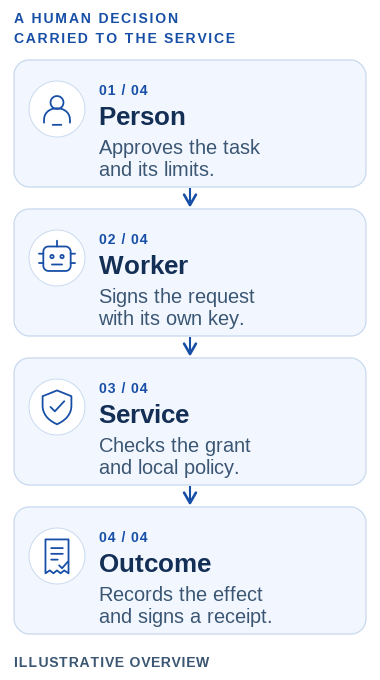
HTTP6 fixes stolen web credentials by replacing reusable tokens and durable secrets with single-use cryptographic authority. Whether a request comes from a person in a browser or an AI agent acting on their behalf, HTTP6 proves who authorized the exact action without exposing a reusable credential that can be stolen, replayed, or broken.
What is information-theoretic security?
Most web security today relies on computational security: a bet that an attacker does not have enough computing power to crack a mathematical puzzle before a key or token expires. Information-theoretic security removes that gamble. Instead of relying on how hard a calculation is, its protection comes from mathematics and fresh, single-use randomness. Even an adversary with unlimited computing power gains no usable information from observing a protected exchange.
How HTTP6 applies it
Today, logging into a website or authorizing an app relies on durable secrets like session cookies, API keys, and bearer tokens. If an attacker steals that token, they can act as you across every system that accepts it.
HTTP6 eliminates reusable credentials from protected requests. For every sensitive action, such as moving money, reading private records, or changing account state, the requester attaches a fresh, one-time proof bound to that specific operation. The receiving service verifies the proof against the explicit human approval before executing the request, then marks the proof as spent. Public assets like stylesheets and images remain fast and unburdened, while protected actions carry verifiable authority.
Built to defeat theft, reuse, and quantum attacks
Stops credential theft: Because the underlying secret never travels across the wire as a reusable token, intercepting a request gives an attacker nothing they can take and use to impersonate you elsewhere.
Prevents reuse and replay: Every proof is minted for one exact action, recipient, and context. Once verified, it is immediately invalidated, making stolen or captured requests useless for subsequent calls or altered payloads.
Resists quantum computing: Classical encryption and signature schemes face eventual collapse from quantum algorithms. Because information-theoretic proofs do not depend on computational hardness assumptions, their guarantees do not degrade as classical or quantum hardware advances.
Bring human intent to every protected action
When copied, bearer credentials can carry access across multiple requests. People have long misused stolen credentials; autonomous AI can extend that threat through rapid actions at scale, sometimes obscuring who directs them. HTTP6 is designed to connect each protected action to the exact authority a person or institution approved, a fresh single-use proof, and a record of its use.
Whether a person or a delegated AI agent makes the request, the receiving service checks the action, destination, and approved limits before protected work takes effect. The moonshot seeks information-theoretic security for identity and communication, with post-quantum completeness as a long-term goal. Explore the security research.
The HTTP6 project is pursuing standards through the IETF and NIST for human-authorized agent actions and web operations. Explore the drafts, technical papers, and opportunities to contribute.
Consider a fixed transfer approved for a particular recipient every Friday. If an agent proposes the entire balance on Thursday, the receiving service can compare the amount, recipient, and timing with the approved policy and refuse an action outside those terms. Fresh proofs and recorded one-time identifiers are designed to keep each protected request tied to its own context.
The HTTP6 roadmap begins with the W1 profile over HTTPS and explores a native HTTP6 channel intended to replace HTTPS on migrated application routes. It envisions lightweight delivery for public assets, while sensitive requests receive the proof and policy checks their actions require. Encryption protects data in transit or at rest alongside those authorization checks. Changing how computers communicate is a moonshot: a massive undertaking involving standards, interoperable systems, and the infrastructure people use every day. Read the global security moonshot
HTTP6 drafts and standards guidance
HTTP6 is pursuing standards through the IETF and NIST. Start with the individual Internet-Drafts on the problem, authority continuity, and the W1 HTTPS profile. The authors also map the proposed architecture to NIST guidance on digital identity, zero trust, and cybersecurity risk. These documents invite technical review and implementation feedback.
Benefits for organizations, institutions, and individuals
HTTP6 is designed to help people and the services acting for them keep AI agent activity within an approved task. When participating systems implement its checks, they can:
Keep people in control. Let a person approve the task, permitted actions, destinations, time limits, and spending limits before an agent acts.
Give each agent only the authority it needs. Assign separate workers their own identities and grants, with delegated permissions that stay within the original approval.
Protect records and resources. Check the actual action and destination against the approval and the receiving service’s rules before releasing data, spending funds, or changing records.
Limit repeated actions. Record a request as spent so a repeated delivery cannot produce a second effect on a protected operation.
Make decisions easier to review. Connect the person’s approval, the acting worker, and the service’s signed outcome so teams can examine what was authorized and recorded.
Recover from a lost response. Allow an authorized worker to ask for an already recorded outcome instead of repeating a completed operation.
Build on existing web infrastructure. Use the proposed W1 profile over HTTPS and evaluate it with the project’s open-source examples.
HTTP6 helps people and organizations define what an agent may do and gives participating services a way to check each protected action. Teams can explore information-theoretic privacy research and optional circuit-generated, one-time proofs alongside independent proof providers. Explore security and deployment
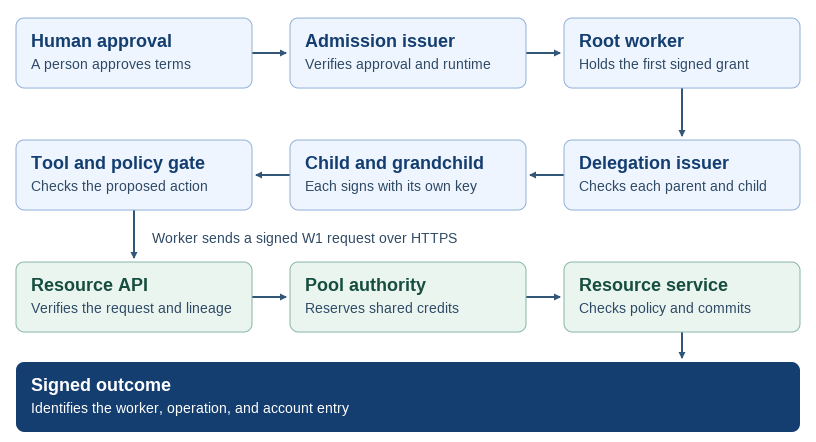
Identity and enforcement in HTTP6. The arrows trace an approval through a family of workers to the service that carries out the action. In this W1 example, a compute charge draws on a shared pool. The service uses current revocation state at commitment and preserves the account entry for later review and recovery.
After someone reviews the task on a trusted display, an issuer records the approval in a signed grant, a statement that names the first worker and the work it may do. If that worker delegates a step, its child receives its own identity and a grant drawn from the parent’s permissions. Delegation can narrow the task, shorten its lifetime, or reduce its allowance.
To preserve the connection to the approved task, an application can record the prompt and the model’s reply. The reply remains a proposal. The worker signs the exact tool request with its own private key, which stays with the worker. The service holding the data checks the signature, the chain of grants, and its current policy before acting. A signed receipt records the outcome so the operator can trace the decision to the resource that carried it out.
For an organization that gives agents access to several systems, this removes the need to give each worker a copy of a person’s broad credential for protected operations. The same model can continue to draft text and propose actions. The controlling change is in the agent host and in each service that can spend, disclose, or modify something on the person’s behalf.
Who changes what in an implementation
The API team protects the account
When a worker asks a compute provider to charge six credits, the API checks its signature, the approved project, and the shared balance. The provider records the charge and returns a receipt over its existing HTTPS connection.
The agent host gives each worker its own authority
For a summary task, a planning agent may assign one worker to read a log and another to write the summary. The host gives each worker its own key and grant. If the model later proposes an export, the receiving service can see exactly which worker asked and what its grant allows.
During a proposed transfer, a broker can review the request, while the storage service controls the records. It checks the destination and current permission again when it would release the bytes. Its receipt tells the operator what the service actually did.
Identity and policy teams supply different evidence
For each request, workload identity can identify the calling service, while a policy engine can evaluate its proposed action against local rules. An HTTP6 integration also presents the person’s grant so the resource can relate that service and action to a particular approval.
In the published W1 example, two workers share ten compute credits. Each asks to spend six. The Node.js and Python implementations recorded one charge and a balance of four whichever worker went first. When a reply was lost, the authorized retry found the existing charge. In the export case the resource released zero records. Both implementations ran on one computer under one operator.
The first profile, W1, uses HTTPS and existing Internet standards for signing messages and identifying their contents. The authors have posted three individual Internet-Drafts with the IETF for Informational discussion. For NIST’s agent identity and authorization work, the authors have prepared a discussion package that relates the design to digital identity, zero trust, and cybersecurity risk management.
The roadmap starts with signed requests on existing HTTPS connections. It then follows independent providers and a managed workspace before reaching a native HTTP6 channel. An application that completes that migration could retire HTTPS and reusable bearer JWTs on its participating routes. Each action would still trace back to the person who approved it.