
What the published tests establish
A signed response identifies the service that produced it. To learn whether a charge actually occurred, a reviewer also needs the service’s account record. The W1 reports include both kinds of evidence and tell the reader who operated the participants.
One allowance, two implementations
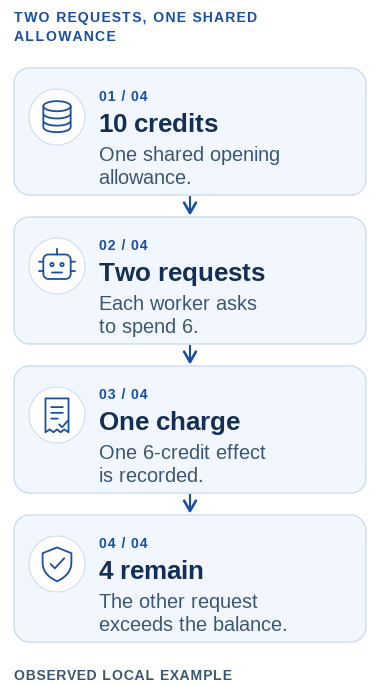
On November 24, 2026, the Node.js and Python/SQLite participants exchanged cases in both directions on one host under one operator. All eleven compared cases agreed. Each forced ordering of the competing requests produced one six-credit charge and four credits remaining. The export case released zero records. Read the reciprocal exchange · Inspect the resource observations · Identify the two builds
A second trial used TLS 1.3 on the same computer. Each direction also carried eight signed transactions to the receiving service. The recorded count for a trial across separately administered Wasmer domains is zero of eleven. Repeating the exchange with separate operators is the next test. Read the TLS trial · Inspect its machine-readable results
An executable check a reviewer can repeat
The W1 kit lets a reviewer repeat the comparisons. A separate synthetic Python example uses the WASIX 02 pilot and precompiled guests to exercise response evidence and a local ledger. The example has its own local pilot and test scope; the earlier finite-model kit remains withdrawn. Run W1 · Run the synthetic example
Wallet authorization and refusal under one grant
The WASIX wallet run recorded 14 signed local entries, one 250-satoshi debit, a signed refusal for a 1,100-satoshi proposal, and a spent replay. Its companion resource suite recorded 141 signed entries across two ledgers. The report includes each run’s public keys, admission grants, policy hashes, payloads and ledger heads. Inspect the signed histories · Read the test observations · Download the evidence and offline verifier
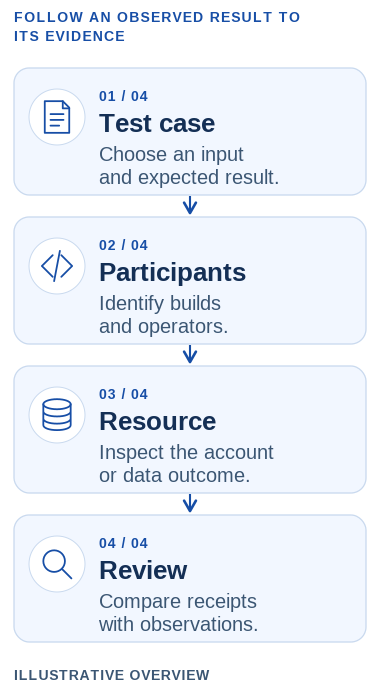
These reports describe the tests and environments identified above. They demonstrate the behavior exercised in those tests. Each production deployment requires its own security evaluation. The optional circuit integration and the open W1 implementation have different proof and verification arrangements. Understand the security claims and deployment choices
The SDK work has also documented a multi-language local synthetic test and its fixture and trust assumptions. Review the test scope and availability
How to read a claim
A theorem states what follows from its assumptions. An execution report names the code and records what it did. A specification tells an implementer what a component must do. A release decision selects a concrete suite or deployment parameter. Each calls for a different check by the reviewer.
For instance, the shared-credit requirement says both workers draw on one balance. The observer report supplies the additional fact that a particular program recorded one charge. See the editions and milestones