
Information-theoretic security
Information-theoretic security expresses a security claim in terms of what an observer can learn, regardless of the observer’s computing power. The project’s research applies that idea to a specific model of credential privacy. Its conclusions depend on the information exposed and on the assumptions in the model.
Claude Shannon’s theory of perfect secrecy provides the broader foundation: under its assumptions, an observer’s probabilities for the underlying message remain unchanged after observing the protected message. Read Shannon’s paper.
A mathematical model of a private response
The research models a secret credential, public challenges, a private dictionary, and fresh private masks. In a round, the challenge maps the selected secret character to a cell. The private dictionary maps that cell to a response, and a fresh mask is added before the response is released.
wₜ = φ(cₜ(kᵣ₍ₜ₎))zₜ = (wₜ + mₜ) mod H
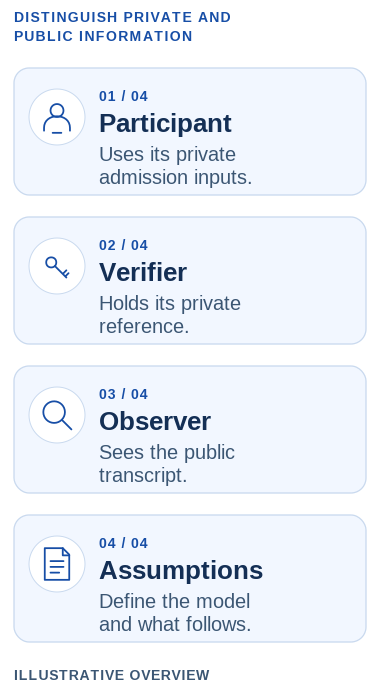
Here k is the secret, cₜ identifies the challenge cell, φ is the private dictionary, mₜ is the round’s private mask, and H is the number of response values. An authorized verifier with the corresponding private information can remove the mask and check the response.
For T rounds, the paper derives Pr[Z = z | X = x, G = g] = H⁻ᵀ under its stated assumptions. With public challenges independent of credential X, it follows that I(X; G, Z) = 0 for the specified public record. In that model the observer’s information about the credential remains unchanged after those observations. Read the equations and derivation.
The assumptions include independently and uniformly sampled secret masks, fresh for each response; public challenges independent of the credential; and protected private computation and mask handling. The paper separately identifies active attacks, verifier behavior, physical observation, and proof-of-knowledge as questions needing their own analysis. Each deployment and data channel requires evaluation against its own exposed information and operating assumptions.
From a privacy model to HTTP6 patterns
HTTP6 explores how a person’s approval can be reflected in a worker’s request, checked against policy at a receiving resource, and recorded with a one-time identifier. A circuit proof can be connected to that pattern through an adapter. Request authorization, replay resistance, transport protection, and runtime security each require their own controls and evidence.
Today’s W1 example uses Ed25519 signatures over HTTPS. It provides a practical way to test the HTTP6 request pattern using its specified signatures and transport. Production properties depend on the chosen provider, proof, randomness, runtime, state, transport, and independent evaluation.
Follow a policy-bound request · Compare deployment choices · Explore the synthetic example
Papers and attribution
The private-reference construction is attributed in the manuscripts to Rosario and Wang. The links below lead to clearly labeled neutral reading editions, with links to the original papers and bylines for independent review. The papers include related questions beyond the privacy model described above.
- Consolidated formalization. Definitions, masking, the observer model, verification, and operational assumptions.
- Complete formalization. Finite partitions, private naming, and the distribution of public responses.
- Unified geometric formalization. Private histories, public observations, and the verifier’s private reference.
- Time-indexed cryptographic geometry. Round-specific geometry and the verifier’s interpretation of a response.
- Exact projection. A separate witness projection question and the assumptions needed for an efficiency result.
- Unified technical manuscript. The proposed connection from human admission to process identity and policy.
Research and mathematical principles are presented for review. An optional circuit implementation has separate intellectual-property and commercial terms. Read rights and licensing.