
Why each request needs its own proof
A person asks an agent to summarize a private file. Reading the file serves that purpose. Sending it to a supplier discloses it. The same account can have permission to do both. The service holding the file needs evidence of which action the person approved for this task.
A bearer access token gives its holder the access it describes until it expires or is revoked. A JSON Web Token (JWT) used this way can be copied. A compromised process can present the copy, and an agent that misreads an instruction can use its own valid token for the wrong purpose. On a protected HTTP6 route, the service requires fresh evidence from the authorized worker for the exact operation and checks the operation against the approved policy. A protected request carries evidence that the receiver can verify. The worker keeps its long-lived signing key local. A password, API secret, or reusable bearer token in a header or body would still be available to whoever receives those bytes, even when the message is signed. Keep those credentials out of the protected message and its ledger entry. How bearer access works · Related OAuth proof of possession
How the service detects a change of policy
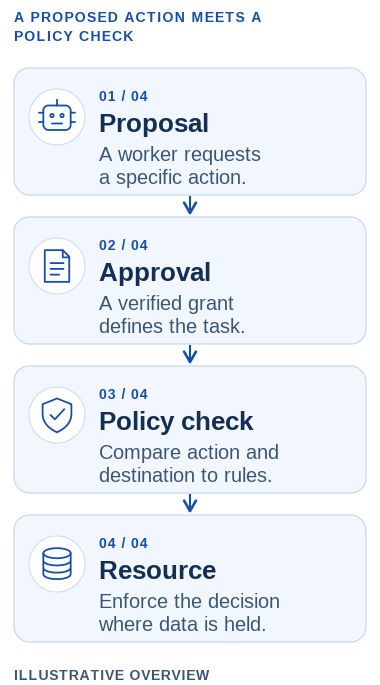
In the policy-gate example, the approval covers a particular document store, the region an agent may edit, and the permitted size of the edit. Both sides encode the policy in the same agreed form and calculate its SHA-256 digest, a fixed-size value derived from those exact bytes. The circuit proof covers the request hash, which includes the approved policy, prompt, destination, and one-time value. The gate checks the proof and recomputes the hashes. Giving a worker a larger editing allowance changes the bytes and the digest. The existing proof still identifies the original approval.
The model’s proposed edit arrives later. The executor checks its actual destination, region, and size against the committed policy before writing. The first check establishes which instruction the person authorized. The second decides whether the proposed edit fits that instruction. Inspect the circuit and policy checks
What makes the proof single-use
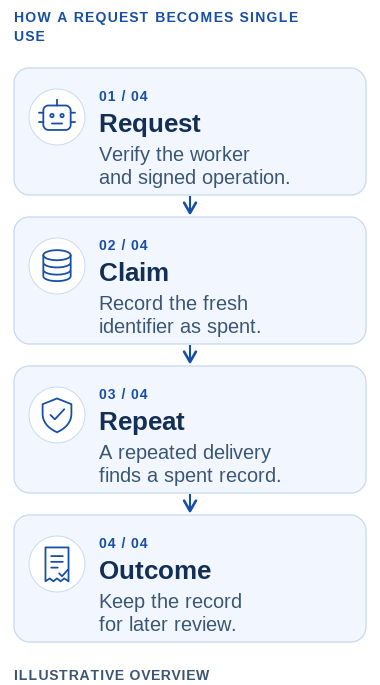
Verifying a signature establishes who signed a message and which bytes they signed. To enforce single use, the receiving service also needs a durable answer to a separate question. Has this authorized request already been presented? The verifier authenticates the request and claims its one-time identifier in shared storage in one indivisible step. When two copies arrive together, one can claim it. The other encounters the spent entry. This transition is what the project calls burning a proof. The evidence stays available for review.
A receiving service rejects a proof that has already been consumed when it verifies and records the proof’s identifier atomically in shared, durable state. Protecting an unused proof against interception or relay also requires appropriate request binding, channel protection, and runtime controls. Review replay and capture
Each new transmission has its own proof. The business operation retains its identifier across retries. If an account service commits a charge and its reply is lost, the worker can sign a fresh inquiry about that operation. The service checks the worker’s current permission and returns the recorded outcome. Its account journal preserves one charge across retries and restarts. Follow a lost reply · Inspect the replay case
What travels in an HTTPS request
In the published W1 profile the worker sends Signature-Input, Signature, and Content-Digest in the HTTP headers. The signature covers the method, target URI, content type, and digest of the body. The body carries the record ID, operation, worker identity, and signed grants. Those grants identify the applicable policy. The provider verifies the signatures and body, resolves the approved meaning of that policy, and applies its current rules at the resource. Read the W1 wire format · HTTP Message Signatures · HTTP Digest Fields
For an application using an optional circuit integration, the adapter supplies the circuit proof and approved policy digest as authenticated application data. At issuance, bind the intended recipient, action, arguments or payload digest, worker and grant, policy digest, fresh event identifier, and expiry. At receipt, reconstruct the statement from what the service actually received. A gateway translating the request must carry that binding through to the service that executes it. The published W1 fields above remain the common HTTPS interface. Find the integration point in your application
What another organization can verify
A resource needs current policy and shared consumption state to decide whether to execute. A reviewer investigating the outcome can work later with a different set of evidence. Using trusted public keys, the reviewer can verify who issued the permit, who signed the receipt, and whether the records identify the same operation, amount, and intent. Comparing the receipt with the resource journal and an independently retained checkpoint gives the reviewer evidence about what the resource recorded. Merely reading a receipt leaves the spent record in place.
Check a six-credit receipt in your browser
In the published test, the pool issued a permit for six credits and the account service signed a receipt for the charge. Your browser can verify the two signatures with the public example keys and compare the records. This checks the saved evidence without contacting an account or spending credits.
The per-message research discusses a designated verifier, which holds private verification material. In a deployment using that model, the verifier can attest to its decision in a separately signed record for other organizations to check. A W1 receipt provides an example of a publicly verifiable record format. The separate WASIX example exercises its own local designated-verifier flow. Read the per-message proof paper · Run the synthetic example
Choosing a proof provider
One implementation signs each request with the worker’s own Ed25519 key and sends the signature, a digest of the payload, and a fresh record identifier. The service verifies the signed request against the grant, applies its policy, and claims that identifier once in durable storage. A team can build, distribute, or sell this implementation under the open HTTP6 license, including an independent proof provider.
An optional circuit integration is designed to provide a one-time proof bound to the approved request and execution context. The recipient checks the evidence while the proving system retains its private material. The information-theoretic privacy research addresses a specific observation model; the integration and complete deployment require separate evaluation. Read the mathematical model. Read the circuit licensing terms · Run W1 with standard signatures