
What a W1 client and resource exchange
W1 gives two teams a common format for a consequential tool call. The client team represents who approved the task and which worker is asking. The resource team verifies those facts, decides whether the operation fits, and signs a response that the client can associate with the request.
Which parts of the message are protected
W1 uses HTTPS with TLS 1.3 for the connection. HTTP Message Signatures let the receiver check the signed method, target, and selected fields. Content-Digest identifies the bytes in the body. Signed grant objects carry the original approval and each delegation. The client keeps its signing key locally and sends the signed request and key identifier. RFC 9421 · RFC 9530 · HTTP Semantics (RFC 9110)
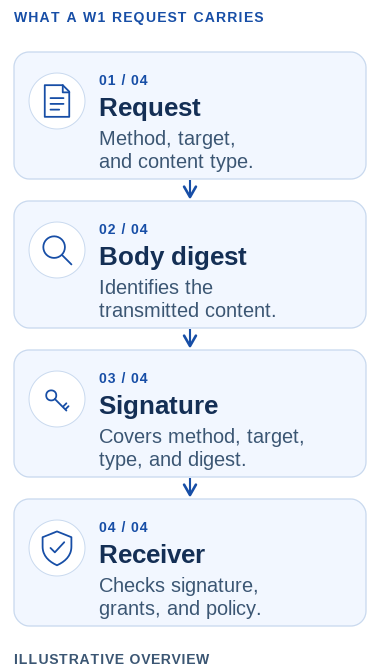
W1 specifies signed HTTP requests over HTTPS and can be implemented with an independent proof provider. An optional circuit adapter can add proof evidence bound to the request. W1 retains its selected signature algorithm and the deployment’s transport security alongside that evidence. Compare the deployment choices
What the resource must decide
Every child grant must fit inside its parent’s actions, lifetime, and spending limits. At /w1/operate the provider verifies the chain and current local policy before recording an effect. If a reply is lost, an authorized inquiry at /w1/status can recover the recorded outcome. Repeating the same intent must preserve one business effect.
The model may recommend an action in natural language. The provider decides on the signed operation, destination, and allowance, so an instruction to export records still requires a grant covering that export. Run the refused export and shared-credit cases
Compare the W1 headers with the optional circuit integration · Verify an example permit and receipt
Implementation resources
Use the W1 cases and vectors for this HTTPS profile. The proposed guide API and experimental WASIX pilot are separate interfaces. Run the W1 cases · Inspect schemas and test files · Compare implementation paths
Read the wire requirements
Official draft and history · Chapter reader · Revision 00 XML