
Run the W1 example
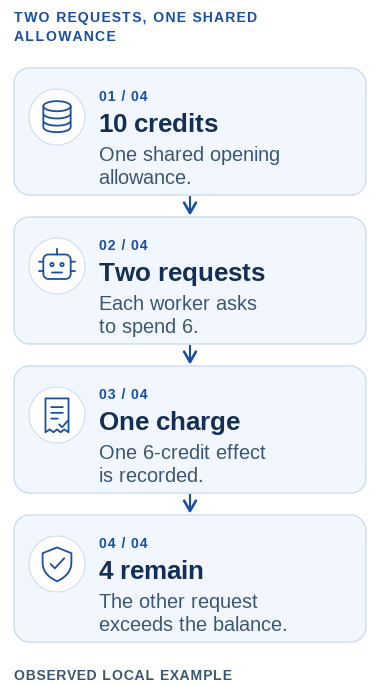
A scientist gives two workers access to ten compute credits for one project. Each worker may spend six. The provider must honor the shared allowance even when the requests reach it together. These files let you inspect the signed approvals and reproduce the provider’s decision.
The project-owned W1 software and examples are open source under MIT. Both participants use standard signing keys and run independently of any optional circuit integration. Download the source with its license · Read the MIT terms
Run the checker locally
Download the W1 interoperability kit, revision 00 and extract it into an empty folder. From that folder, use Node.js 22 or later to run the following commands. The fixture keys and account records were created for this example.
cd w1-public-vectors-00
node check.mjs
node check.mjs compare case11-examples/a-to-b.json case11-examples/b-to-a.json
The checker reports 46 signed objects, 24 HTTP entries, 19 scenarios, and five comparison controls. The second command reports MATCH when both example reports agree. In case 07, look for one six-credit charge and four credits remaining. In case 06, a denied export releases zero records.
Inspect the individual cases
Read the fixture guide · Inspect the vector manifest · Check the download’s SHA-256
Compare the two participants
The kit also contains the Python/SQLite participant and the reports exchanged on November 24, 2026. A separate TLS trial recorded both directions on one host. For background on database transaction behavior, see the SQLite transaction documentation. An independent operator can use these same inputs to compare a separate implementation with the published outcomes.