
Read the API guide and schemas
Review the proposed request and response contract, proof formats, validation rules, and schema references.
Begin with the HTTP6 drafts and architecture, then explore proposed interfaces and experimental examples that illustrate the design. Read the Internet-Drafts · Explore the W1 profile · Connect specifications to implementation
The HTTP6 SDK supports one network application in a global mission for identity privacy and cybersecurity for everyone. The long-term research goal is to apply information-theoretic security to digital systems under explicitly stated assumptions. Read the mathematical foundation. This repository gives developers the HTTP6 interfaces and evidence to inspect, implement, and compare an early application. The current W1 profile uses Ed25519 over HTTPS. Read the global mission, its human stakes, and its destination.
Browse the HTTP6-ORG SDK repository for API documentation, schemas, SDK source, and runnable examples. The repository also provides compiled demonstration guests, while circuit source remains private. Review the repository notices before using the demo files, and use GitHub Issues to contribute feedback.
Review the proposed request and response contract, proof formats, validation rules, and schema references.
Inspect the public pilot host that exposes the experimental HTTP6 API routes and connects them to the compiled demonstration guests.
Open the Node.js, Python, Rust, Go, and C# SDK packages and their proof verification code.
Find language examples, cross-runtime demonstrations, and one runnable source example for each adversarial card.
Browse precompiled WASIX demonstration guests, checksums, validation notes, and the accompanying use notices.
Start with a transaction whose outcome you can inspect. Two workers each request six credits from a ten-credit account. The client must identify the worker and its grant. The provider must keep the common balance and record the charge once.
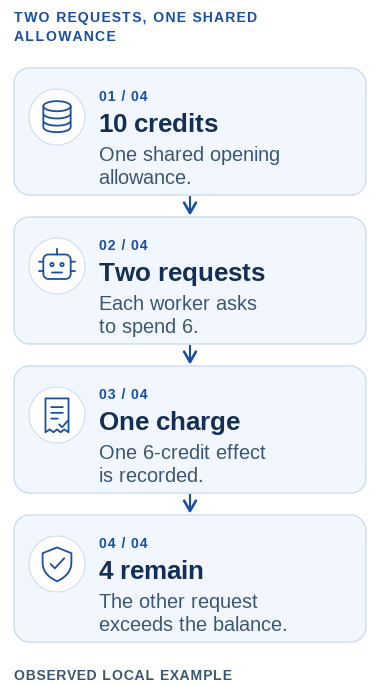
Follow one operation through the system · Locate your integration point
Repeat controlled stolen-token, replay, key-file, response and prompt-boundary tests, and inspect the results.
Map protocol concepts to proposed API operations, W1 cases, pilot capabilities, and their current evidence.
Review proposed admission, proof, operation, ledger, and recovery endpoints and their relationship to the drafts.
Review the experimental SDK and local examples, their current availability, and the implementation paths.
Follow an allowed payment, a broker-signed refusal, and a replay. Inspect the original ledger entries and try changes against the verifier.
Download both participants and the signed cases. Compare the account balance, a refused export, and a retry after a lost response.
Use the public Python adapter and precompiled demonstration guests to inspect allowed and refused actions, evidence, and a local ledger.
Follow a proposed command from the model to the separate component that decides whether to execute it.
Identify what SPIFFE, Open Policy Agent, Cedar, and a WASIX runtime could supply to your implementation.
Use the proposed package responsibilities to divide client, resource, storage, and interoperability work between teams.