
Where existing tools fit
A team may already know which service is calling and have rules for its accounts. The remaining question is how the receiving service connects a particular call to what a person approved. The following integration designs identify what the existing tool supplies and what the HTTP6 implementer must add.
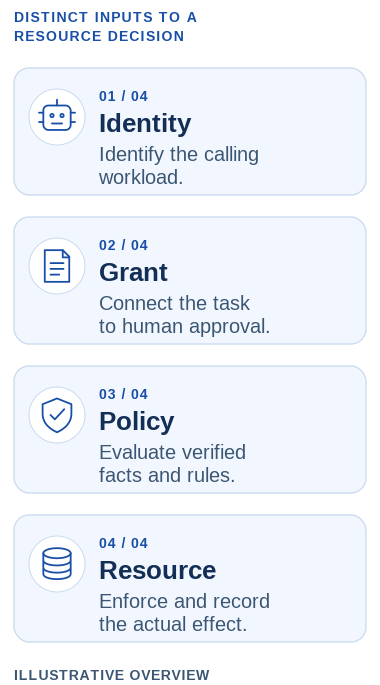
Where each team connects its system
- Approval interface and grant issuer
- Pass the approved terms, the human authenticator’s signature, and the worker’s signed admission record to the issuer. Its signed root grant gives the resource evidence of the person’s decision. Follow approval
- Agent host and tool adapter
- Give each worker a key and a grant for its task. Translate the model’s proposed tool call into an action and destination that a policy evaluator can check. Follow delegation · Verify hereditary identity · Follow a tool call
- HTTPS client and resource API
- Send the signed operation to
/w1/operate. Verify the signature, body digest, authorization chain, and current worker identity at the receiving service. Follow the signed request - Shared budget and account storage
- Reserve the proposed amount against the shared pool. At the resource, connect the exact permit and operation to the transaction that writes the account row. Follow the charge
- Status, recovery, and review
- Connect
/w1/statusto the durable operation record. Preserve spent authority through recovery and match the signed outcome to the original request during reconciliation. Follow a lost reply · Read the receipt
Carrying the proof to the system that acts
Choose one resource-changing operation and identify every route that can perform it. Bind the approved policy and intended arguments to the worker’s request. Each route must reach a verifier that checks the actual operation, consumes its one-time identifier in shared durable state, and records the outcome. These are application integration designs. W1 specifies the HTTPS exchange.
A circuit-proof adapter should bind the circuit proof to the intended recipient, worker, action, request content, approved policy, fresh identifier, and expiry. The receiving service must reconstruct and verify that binding from the request it receives and enforce its own resource policy. Review security and deployment
- HTTP APIs and service calls
- Place the W1 signature and body digest in HTTP headers. Carry the signed grants in the body. A team can implement signing, policy binding, and replay checks under MIT with its own keys and proof provider. If the application selects an optional circuit adapter, the integration carries a circuit-generated proof and policy digest in authenticated application data. Read the terms for the circuit integration Check the intended service and the exact request at the receiving API.
- System commands
- Pass the proof alongside a structured command to a trusted launcher. Bind the executable, individual arguments, target resource, and approved policy. The launcher compares those fields to the command it will execute and records the result for that operation.
- Database requests
- Carry the proof with a named operation and its typed parameters. Bind the database, tenant, and affected records to the request. The procedure or data service verifies what will be written and records the consumption decision and the write in one transaction where the storage engine supports it.
- Queues and calls between processes
- Send the proof with the message and name the receiving process or queue in the authenticated request. The consumer verifies the worker and payload when it dequeues the work. All replicas use the same durable record of spent identifiers so redelivery cannot repeat a committed operation.
Test four outcomes at the resource. An approved call produces one effect. A repeated delivery finds a spent identifier. A changed policy or payload fails verification. A worker that loses the reply can send a fresh authorized inquiry and recover the first receipt. Verify a signed example receipt · Inspect recovery
Identifying a workload with SPIFFE
SPIFFE assigns identities to workloads such as a process that operates a queue. An integration could use that identity when deciding which issuer or runtime to trust. The receiving resource would still verify the human approval, the worker’s delegated scope, and the signature on the exact operation. SPIFFE overview
Evaluating local rules with Open Policy Agent
An API can ask Open Policy Agent whether a named worker may export a particular dataset. The API supplies verified grant fields and current resource facts as inputs. It must enforce the decision at the export endpoint and bind its receipt to the bytes and destination it accepted. Open Policy Agent documentation
Expressing permissions with Cedar
Cedar evaluates permissions for a principal, an action, and a resource. An adapter would map a verified worker and operation to those entities, then combine the local decision with the limits inherited from the human grant. The account service still records whether the action took effect. Cedar language reference
Restricting the worker’s execution environment
A WASIX runtime can limit which files and services a worker can reach. HTTP6’s proposed gateway would give an admitted worker only the capabilities needed for its task. A storage or payment service would verify the request again before releasing data or settling a charge. Read the gateway and recovery design · Wasmer runtime documentation