
How identity and policy travel through delegation
Each descendant acts as itself. What it inherits is permission to do a particular part of the work. A service can identify both the worker at its door and the person at the origin of the task because signed grants connect each generation to its parent and to the original approval.
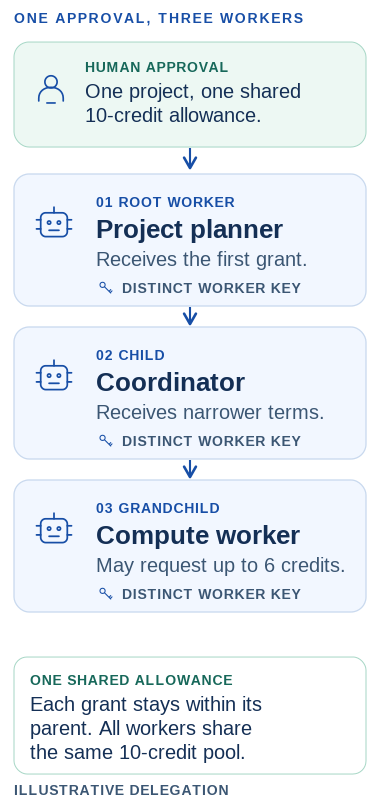
One approval, three generations of workers
Consider a scientist commissioning an analysis. Select a handoff to see who signs, what the next participant receives, and what a verifier checks.
-
ScientistOrigin of the approval
The scientist approves ten compute credits for one analysis project and permits the work to be delegated. The approval identifies the provider, purpose, actions, spending terms, and expiry.
The approval client displays the terms. The enrolled person’s authenticator signs those exact terms and a fresh challenge. The admission issuer verifies the response and consumes the challenge so it represents one decision.
-
Project plannerRoot worker
The planner receives a root grant naming its own workload, key, and current generation. Generation identifies which running instance of that workload has been admitted.
The planner signs a join record for the displayed terms. A trusted runtime appraiser binds the planner’s key to its running instance. The admission issuer checks the approval, join, and appraisal together, then signs the root grant with a reference to the human approval.
-
Analysis coordinatorChild of the planner
The planner delegates the analysis to a coordinator. Its grant carries the same project and shared budget, a shorter lifetime, and permission to assign one further stage.
The planner signs a request identifying the grant it holds, the proposed terms, and the coordinator’s signed join record. After checking both signatures, the coordinator’s appraisal, and the planner’s current delegation right, the delegation issuer signs a grant naming the coordinator’s distinct holder and key.
-
Compute workerGrandchild of the planner
The coordinator authorizes a compute worker to request up to six credits for this project. Its delegation depth is zero. The worker signs the six-credit call with its own key, and the provider can trace the call through both ancestors to the scientist’s decision.
The same issuance checks apply at this handoff. The grandchild’s signed grant names its immediate parent and the original root. When the worker calls the provider, its HTTP signature covers the request method, destination, content type, and digest of the body.
What a child inherits
In the W1 profile, every link carries the same root, service, account, project, purpose, shared budget, policy identifier, and operating epoch. Each child names its immediate parent and gets a distinct holder and key. Its permitted actions fit within the parent’s actions, its validity period fits within the parent’s period, its spending ceilings can stay the same or decrease, and its remaining delegation depth decreases.
The original ten credits therefore remain one allowance for the family. Giving two children authority to request six credits apiece still leaves ten credits to distribute across their work. Inspect the measured account outcome
How proof becomes an enforced decision
- Verify who vouched for each link. The receiving API checks the issuer signatures against its trusted keys, follows each parent reference back to the root, and compares the child’s terms with its parent’s. It checks the current runtime appraisal and verifies the request with the key registered to the calling worker.
- Evaluate this operation. The resource matches the signed project, action, purpose, amount, and destination to the verified grant and its own current rules. It checks expiry and revocation. A new instruction in a prompt can propose an action for this check. Changing the approved terms requires a fresh authorized decision.
- Enforce the decision where the effect occurs. For the six-credit charge, the pool reserves the amount for this worker and operation. The account service rechecks the permit and current policy when it commits the entry. Its signed outcome names the holder, root, operation, and account row, giving the reviewer a path back to the original decision.
What crosses an organizational boundary
The admission service can retain the human authentication evidence. The provider can verify the issuer’s signed root grant, the descendant grants, and the worker’s request using the information relevant to its own decision. The architecture calls for audience-specific references so the provider can trace authority for this project while the admission service manages the person’s identity record.
For background on identity proofing and authentication, see NIST SP 800-63-4. The project’s private-reference research examines how a verifier can check a person’s admission proof. The W1 examples use a registered authenticator key to exercise the approval and delegation interfaces. In both discussions, human admission establishes the origin and each running worker supplies its own evidence. Read the admission research · Follow the signed request
A proof can bind a request to an identified worker and its approved authority. The operator must also establish and protect the worker’s runtime identity, its private material, and the paths by which it can reach protected resources. Review the deployment considerations
Check your implementation
The W1 fixtures give issuer and resource teams concrete checks. Case 01 binds approval to the displayed terms, case 02 checks child grants, and case 04 tests whether the resource recognizes the complete chain and its current policy. Run the examples · Read the W1 record definitions