A global future for identity privacy and cybersecurity
The goal is identity privacy and cybersecurity for every person, at the scale of a world with 10 billion people. The proposed future develops information-theoretic security to protect identity and communication without relying solely on limits to an attacker’s computing power. HTTP6 is one early application for human authority over AI agents and web operations. Explore the security research.
The HTTP6 project is pursuing standards through the IETF and NIST for human-authorized agent actions and web operations. Explore the drafts, technical papers, and opportunities to contribute.
A global task: change digital security at its foundation
The global goal is identity privacy and cybersecurity for every person, with systems built to serve a world of 10 billion people. Stolen credentials, impersonation, exposed data, and financial harm are already part of digital life. The moonshot is to develop information-theoretic security as a foundation for future cryptography. HTTP6 is one early network application, with a research path from private proofs to policy-bound actions. Read why the world needs this change and where it is going
HTTP6 drafts and standards guidance
HTTP6 is pursuing standards through the IETF and NIST. Start with the individual Internet-Drafts on the problem, authority continuity, and the W1 HTTPS profile. The authors also map the proposed architecture to NIST guidance on digital identity, zero trust, and cybersecurity risk. These documents invite technical review and implementation feedback.
Benefits for organizations, institutions, and individuals
HTTP6 is designed to help people and the services acting for them keep AI agent activity within an approved task. When participating systems implement its checks, they can:
Keep people in control. Let a person approve the task, permitted actions, destinations, time limits, and spending limits before an agent acts.
Give each agent only the authority it needs. Assign separate workers their own identities and grants, with delegated permissions that stay within the original approval.
Protect records and resources. Check the actual action and destination against the approval and the receiving service’s rules before releasing data, spending funds, or changing records.
Limit repeated actions. Record a request as spent so a repeated delivery cannot produce a second effect on a protected operation.
Make decisions easier to review. Connect the person’s approval, the acting worker, and the service’s signed outcome so teams can examine what was authorized and recorded.
Recover from a lost response. Allow an authorized worker to ask for an already recorded outcome instead of repeating a completed operation.
Build on existing web infrastructure. Use the proposed W1 profile over HTTPS and evaluate it with the project’s open-source examples.
HTTP6 helps people and organizations define what an agent may do and gives participating services a way to check each protected action. Teams can explore information-theoretic privacy research and optional circuit-generated, one-time proofs alongside independent proof providers. Explore security and deployment
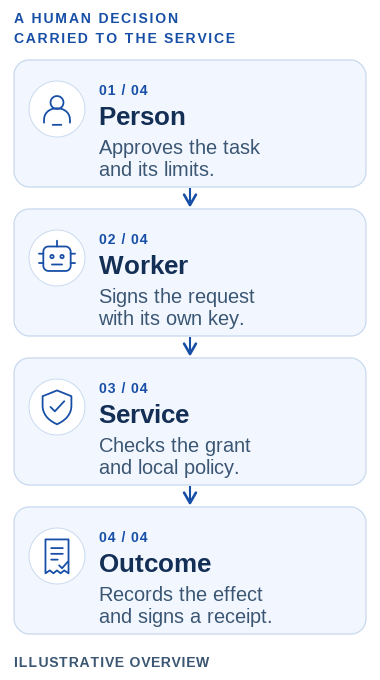
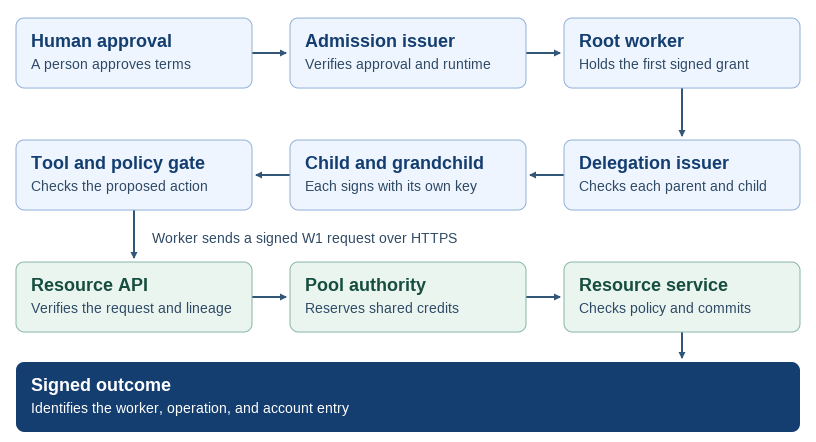
Identity and enforcement in HTTP6. The arrows trace an approval through a family of workers to the service that carries out the action. In this W1 example, a compute charge draws on a shared pool. The service uses current revocation state at commitment and preserves the account entry for later review and recovery.
A person reviews the task on a trusted display. An issuer records the approval in a signed grant, a statement that names the first worker and the work it may do. If that worker delegates a step, its child receives its own identity and a grant drawn from the parent’s permissions. Delegation can narrow the task, shorten its lifetime, or reduce its allowance.
An application can connect the prompt and the model’s reply to the approved task. The reply remains a proposal. The worker signs the exact tool request with its own private key, which stays with the worker. The service holding the data checks the signature, the chain of grants, and its current policy before acting. A signed receipt records the outcome so the operator can trace the decision to the resource that carried it out.
For an organization that gives agents access to several systems, this removes the need to give each worker a copy of a person’s broad credential for protected operations. The same model can continue to draft text and propose actions. The controlling change is in the agent host and in each service that can spend, disclose, or modify something on the person’s behalf.
Who changes what in an implementation
The API team protects the account
When a worker asks a compute provider to charge six credits, the API checks its signature, the approved project, and the shared balance. The provider records the charge and returns a receipt over its existing HTTPS connection.
The agent host gives each worker its own authority
A planning agent may assign one worker to read a log and another to write the summary. The host gives each worker its own key and grant. If the model later proposes an export, the receiving service can see exactly which worker asked and what its grant allows.
A broker can review a proposed transfer, but the storage service controls the records. It checks the destination and current permission again when it would release the bytes. Its receipt tells the operator what the service actually did.
Identity and policy teams supply different evidence
A workload identity can identify the calling service. A policy engine can evaluate its proposed action against local rules. An HTTP6 integration also presents the person’s grant so the resource can relate that service and action to a particular approval.
In the published W1 example, two workers share ten compute credits. Each asks to spend six. The Node.js and Python implementations recorded one charge and a balance of four whichever worker went first. When a reply was lost, the authorized retry found the existing charge. In the export case the resource released zero records. Both implementations ran on one computer under one operator.
The first profile, W1, uses HTTPS and existing Internet standards for signing messages and identifying their contents. The authors have posted three individual Internet-Drafts with the IETF for Informational discussion. For NIST’s agent identity and authorization work, the authors have prepared a discussion package that relates the design to digital identity, zero trust, and cybersecurity risk management.
The roadmap starts with signed requests on existing HTTPS connections. It then follows independent providers and a managed workspace before reaching a native HTTP6 channel. An application that completes that migration could retire HTTPS and reusable bearer JWTs on its participating routes. Each action would still trace back to the person who approved it.