
HTTP6 protocol roadmap
HTTP6 starts with a change an API team can make today. Keep the HTTPS connection, give each worker its own signing key, and require proof of what a person authorized for each request. The long-term goal is to move an entire application onto native HTTP6, where participating clients and services could retire both HTTPS and reusable bearer tokens on their shared routes.
This roadmap follows HTTP6 as one early network application in a global effort to provide identity privacy and cybersecurity for everyone. The proposed destination is to develop information-theoretic security for digital systems, with each claim tied to its assumptions and independently reviewed. Explore the mathematical foundation. Current HTTP6 stages move from W1 signed requests over HTTPS toward a proposed native channel. Read the global problem, human stakes, and long-range destination.
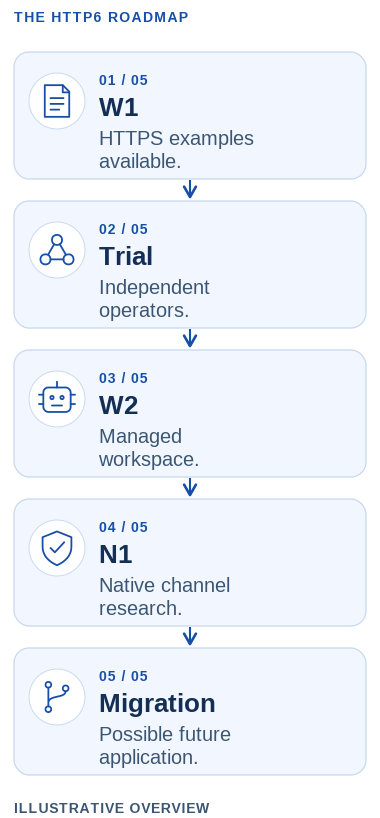
Stage 1 · W1 reference implementations available
Sign requests over HTTPS
Consider a scientist who authorizes ten compute credits. TLS 1.3 authenticates the service and protects the connection. Over that connection, the worker signs a fresh request that identifies the destination and includes a digest of its contents. The provider checks the worker’s grant, the scientist’s spending policy, and the one-time record identifier before it charges the account. A copied bearer token or a stolen server TLS key cannot produce the worker’s signature. Replaying a previously accepted request cannot create a second charge.
In the published W1 trials, two workers each requested six credits from the same ten. The Node.js and Python implementations recorded one charge and a balance of four. After a lost reply, an authorized retry recovered the original receipt. Both participants ran on one computer. Run the W1 examples · Read the trial results
Stage 2 · Next interoperability trial
Prove interoperability across organizations
A provider that runs its own systems must be able to tell which issuer vouched for a worker and which resource actually recorded the charge. The next trial asks two independent operators to exchange the same signed requests in both directions over TLS. Each keeps its own keys, policy, and account journal. Comparing their receipts and balances shows whether both enforce the same approval.
On a route that passes these checks, the operator can retire its reusable bearer JWT as the credential that authorizes work. A JWT is a format for carrying claims. The security change is that a copied credential can no longer authorize a fresh action. Every route capable of making the charge, including a background queue or a direct internal call, must enforce the same rule. Find the enforcement points · Join the independent trial
Stage 3 · W2 managed workspace design
Bind the workspace to the approval
The scientist should be able to see the project, provider, and spending limit before approving the work. W2 would bind those displayed terms to the running worker. An LLM could propose further work, and a parent worker could delegate a smaller task. The file system and receiving APIs would check each requested action against the approval that survived those handoffs. HTTPS can continue to carry the traffic.
To demonstrate this stage, a managed client must preserve the approved destination through page loads, form submissions, and downloads. A replacement worker must obtain fresh authority, while the account service preserves the record of proofs already spent. Trace a grant through three generations · Read the recovery design
Stage 4 · N1 native-channel research
Pilot a native encrypted channel
In a native pilot, an HTTP6-aware client would connect directly to an HTTP6-aware service. HTTP6 would take over the jobs that TLS performs today. The peers must discover and authenticate each other, establish encryption keys, protect each record against alteration, rotate keys, and detect a forced switch to a weaker protocol. Each protected request would also carry proof of authority for that particular operation.
The first milestone is a controlled endpoint. Before migration, independent implementations would need to exchange the same records, preserve confidentiality and integrity through reconnection, and demonstrate replay protection and recovery after failure. The native specification identifies twelve open decisions, including the cryptographic suite, source of fresh private material, and recovery trust. Inspect the twelve decisions · See the technical milestones
Stage 5 · Long-term deployment goal
Move an entire application to HTTP6
An operator could migrate a complete application once its clients, APIs, background workers, assets, and recovery paths can all use the verified native channel. On those routes, HTTP6 could wholly replace HTTPS for transport and bearer JWTs for authorization. A migrated endpoint could retire its TLS certificate and private key for that connection. A partner still using HTTPS would continue through a separately configured gateway.
The practical benefit is that a worker could act on a person’s behalf without carrying a reusable password or bearer token from service to service. The receiver would authorize each action from its current policy, a fresh proof, and a durable record of prior use. Operators would still protect enrollment and recovery material, private proof state, and channel keys. Read the full architecture specification