
Decisions for a native HTTP6 channel
A native channel would carry the proof-bearing exchange directly. Two independent teams would have to agree on how endpoints find and authenticate each other, how a record is encoded, and what to do when the connection or a machine fails. This blueprint is for engineers evaluating those choices. TLS 1.3 is useful background for the existing transport; the proposed native channel still needs its own design and review.
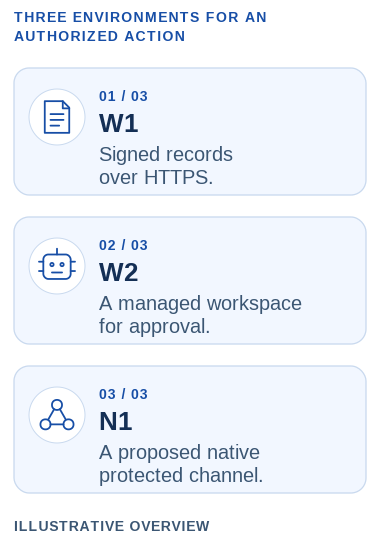
How the specification divides the work
Part II follows the exchange from discovery to execution and recovery. Each step names a responsibility that an implementation must assign to a component.
- II. Introduction and design thesis
- II.1 The architectural question
- II.2 Names, products, and technology layers
- II.3 Trust principles and core protocol invariants
- II.4 What changes from the conventional stack
- II.5 Fourteen protocol phases (page-to-asset lifecycle)
- II.6 Opening human proof and twin oscillation
- II.7 Session lifetime and route transitions
- II.8 Protocol model, roles, and records
- II.9 Client/server APIs, headers, and errors
- II.10 Browser and WASIX deployment architecture
- II.11 Wasmer/WASIX service stack
- II.12 Suggested source modules and boundaries
- II.13 Human and automated authorization families
- II.14 Implementation work packages
- II.15 Operational security, monitoring, recovery
- II.16 Open engineering decisions
- II.17 Architectural conclusion
- Appendix A. Vocabulary and source basis
The twelve open decisions
Each decision names an agreement two teams would need to reach. For example, both endpoints must identify the same beginning and end of a record before they can verify a signature over it. Download the decision register
- ND-01 · Trusted discovery
- Specify how a client finds the service and recognizes its issuer. A client contacting the service for the first time must also be able to recognize when its key expires or is withdrawn.
- ND-02 · Native crypto suite
- Choose how endpoints authenticate each other, agree on secret keys, confirm the exchange, encrypt messages, and replace the keys during a session.
- ND-03 · Native wire format
- Choose one byte encoding, record length limits, and rules for extensions and errors. Both implementations must identify the same record when reading the wire.
- ND-04 · Private-resource provisioning
- Define where fresh private material comes from, who holds it, and how it is allocated, retired, and replenished. The privacy argument depends on the properties of that source.
- ND-05 · Local hardware and screen
- Define how a verifier checks the device and how the device protects its keys, screen, and input. The person must be able to identify the action the device will approve.
- ND-06 · Distributed state
- Decide how replicas agree on spent allowances and completed operations. After a failure, the replacement must preserve the recorded balance and exclude stale state.
- ND-07 · Application adapter
- Define how an application represents the requested action and data, applies its permission rules, and records a single effect when the same operation is retried.
- ND-08 · Child identity
- Define how a receiver recognizes the issuer of a child grant and checks its permissions, budget, expiry, and revocation against the parent’s authority.
- ND-09 · Browser
- Specify which origin controls a page, how scripts and downloads are contained, and how a person using a keyboard or screen reader examines the same approval.
- ND-10 · Streaming
- Define where a stream divides into chunks, what an acknowledgement confirms, and how peers handle order, loss, retransmission, congestion, and closure.
- ND-11 · Recovery
- Identify what can still be trusted after a failure, who may authorize a restart, and how a recovering fleet selects the current checkpoint and rejects stale state.
- ND-12 · Assessment and release
- Identify the requirements, parameters, and enforcing components for the deployed profile. An independent reviewer needs the implementation records, test results, and approvals for that release.