
Three ways to carry an authorized action
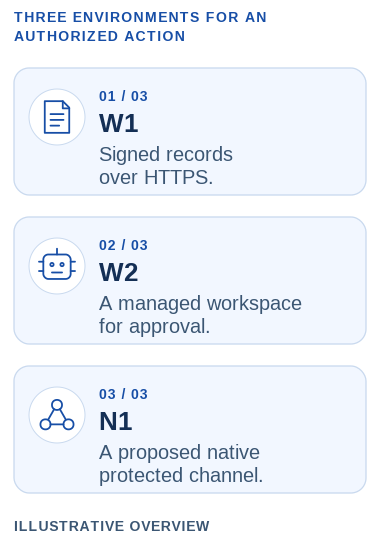
A profile specifies the environment that carries an authorized request. The same human decision poses a different engineering problem at a web API, on a user’s screen, and inside a new network channel.
See when each profile enters the protocol roadmap
Start with W1 for an existing API
W1 carries signed application records over HTTPS. HTTP Semantics (RFC 9110) describes the underlying HTTP model. A client developer signs the operation and body. The resource verifies the worker, grant, and local policy before committing the effect. The test suite lets both sides compare the result against the same fixture. Read the W1 wire rules · Run the example
W2 brings the decision to a managed workspace
A person approves what a screen presents. The W2 design asks how a managed client can bind the visible terms and protected input to the actual request. Browser and endpoint teams would need to show that rendering, script execution, and downloads preserve those terms. Explore the browser questions
N1 explores a native channel
N1 would carry the exchange over its own authenticated channel. Its implementers must choose the handshake, cryptographic suite, encoding, and recovery rules, then show that separate participants agree on the same records. Review the twelve native decisions
The synthetic Python example exercises a separate local WASIX pilot with precompiled demonstration guests. It exercises its own local pilot and test scope; the earlier finite-model kit remains withdrawn.