
Security and deployment
Explore information-theoretic privacy research, compare proof providers, and inspect deployment controls.
When a worker asks a service to act, the service needs an answer to two questions. Who gave this worker authority, and does that authority cover the action it is proposing now? For related resource-focused guidance, see NIST SP 800-207 on zero trust architecture. The architecture assigns each answer to a component whose decision can be checked later.
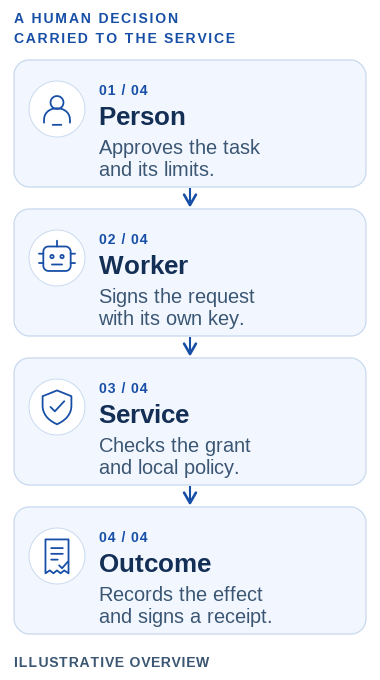
View the logical architecture · Follow an operation through seven steps · Explore the protocol roadmap
HTTP6 combines delegated authority, request proofs, resource-side policy checks, and records of decisions. An optional circuit integration is designed to bind a proof to the approved request and context. Explore the information-theoretic security research.
Explore information-theoretic privacy research, compare proof providers, and inspect deployment controls.
Trace how the resource checks the exact action, marks its proof as spent, and gives another organization a receipt it can verify.
See who signs for the root, child, and grandchild, and how the provider checks inherited policy before recording a charge.
Follow one approval from a person to a worker and then to the account record. This is the starting point for teams designing grants or verifying them.
Choose the profile for your system. W1 carries signed calls over HTTPS, W2 proposes a protected workspace, and N1 explores a native channel.
See why the service that owns a file checks a transfer again after a broker has approved it.
Follow the new identity and retained account state that a replacement worker needs after a restart.
Locate the engineering requirements for a particular client, gateway, fleet, or resource service.