
How a broker and a custodian share a decision
A system that releases a confidential file has two jobs. It must decide whether the transfer is allowed, and it must control the service that can actually release the bytes. In the mediated design a broker reviews a worker’s proposal and a custodian controls the file. A ledger records their separate decisions. NIST SP 800-207 provides related guidance on resource-level access decisions.
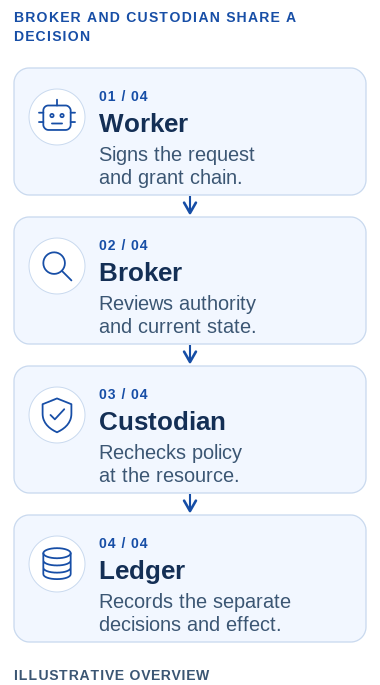
What happens to a request
The worker submits its signed request and its chain of grants. The broker checks the human approval, remaining allowance, and revocation state. If it endorses the request, the custodian verifies the endorsement and checks current policy again at the moment of release. The custodian’s receipt identifies the request and the effect it committed. A signed refusal leaves a record explaining where the request stopped.
Why the execution point matters
A broker may approve a transfer just before the owner revokes access. A custodian that checks the current generation can stop that transfer before disclosure. The same check must cover every supported route to the file, including maintenance and direct API calls. Separating the ledger operator, broker, and custodian also lets a reviewer inspect whose decision each signature represents.
The two architecture chapters
Service owners can use the chapter on policy-bound execution to place the check. Distributed-systems engineers can use the chapter on ledger organization and consensus to examine ordering and trust assumptions.