
Running and recovering a restricted worker
A host can give a worker a handle for one file or service when it starts. The architecture uses WASIX, a WebAssembly execution environment, to explore how narrowly a gateway can provision those handles. This design is for operators who must isolate workers and restore service after a failure. Wasmer runtime and capability-based sandbox documentation
Delivering a page within the grant
The proposed gateway verifies the request and dispatches it to a worker with restricted capabilities. The delivery milestone asks the team to serve HTML, a stylesheet, an image, and a second page while checking which tenant and resource each request belongs to.
What the operator would test
| ID | Title | Gate |
|---|---|---|
| M3 | WASIX web delivery | The gateway must serve a page, its stylesheet, its image, and a second page. The client checks each resource before displaying it. |
| M5 | Agent/fleet | Each machine must identify its running worker. A revoked grant must stop delegated work, including after a restart. |
| M6 | Disaster recovery | A recovery environment or an authorized human must establish a new operating period while preserving the record of proofs already used. |
Recovering the authority as well as the software
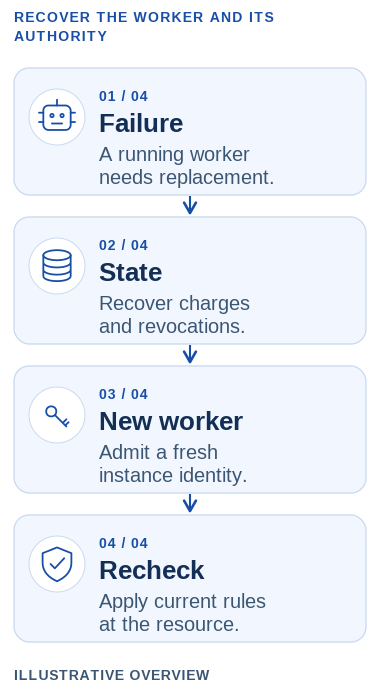
A replacement worker needs a fresh instance identity. An operator also needs the resource’s last settled charges, current revocations, and recovery generation. Otherwise a restored account could allow a worker to spend the same credits twice. The design describes an attested restart, a separate protected recovery machine, and a human-authorized fallback.
Restarting several workers
Fleet policy determines which children can rejoin after a restart. New workers receive fresh grants for the current generation. The resource retains the record of earlier spending and honors outstanding revocations.