
How a person’s approval reaches a worker
A person can leave a task running while a service assigns its parts to several workers. Later, the database or payment provider needs to know which worker is calling and which actions the person authorized. The authority-continuity draft describes the records that let the resource answer both questions.
From a displayed decision to a receipt
The admission client displays the service, purpose, permitted operations, destination, lifetime, and allowance. Once the person approves those terms, an issuer signs a root grant naming the first running instance. A child grant gives a particular worker a subset of its parent’s actions, time, and budget. The worker signs its request locally.
The receiving service verifies the signatures and delegation history, checks current revocation and spending state, and applies its own rules. It records the outcome when the requested operation takes effect. That receipt gives an operator evidence of the service’s action even if the worker loses the reply.
Inspect identity and proof at each generation
Two workers draw on one account
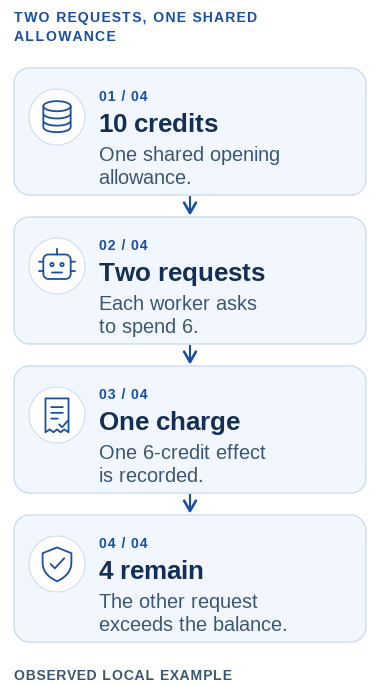
Two workers may each request six credits from a shared ten-credit allowance. After the first charge the account has four credits, so the second request exceeds the shared balance. The published reciprocal test recorded one charge in either order. Inspect the recorded result
The separate guide API proposes admission and delegation operations that developers can review alongside this draft. See the admission and delegation mapping
For implementers and reviewers
For related identity and access guidance, see NIST Digital Identity Guidelines and NIST Zero Trust Architecture. Identity teams define the issuer and runtime evidence. Resource teams define the account effect and receipt. Both can use the same draft to agree on which facts cross the service boundary. Read the posted draft · Read by chapter