
How HTTP6 relates to NIST guidance
The National Institute of Standards and Technology publishes guidance on establishing digital identity, making access decisions, and managing cybersecurity risk. The HTTP6 authors prepared these technical papers for discussion of how a human approval can follow an agent into a tool call. The HTTP6 project is pursuing a new NIST standard for human-authorized agent actions.
What the proposed demonstration would show
A team can give one software worker a limited task, delegate one step to a second worker, then ask an independently run service to verify what each worker may do. The technical contribution identifies the human approval, the two runtime identities, and the fields the receiving service checks. Read the technical contribution · NCCoE agent identity and authorization project
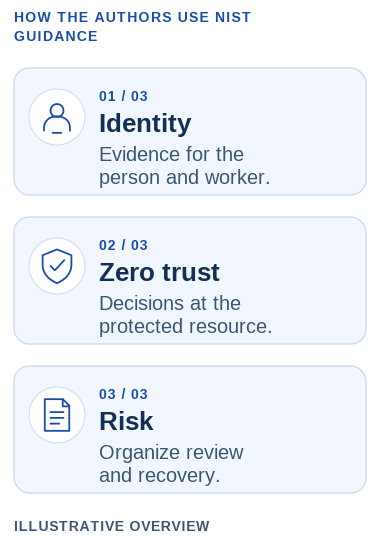
Which guidance the authors use
Digital identity. SP 800-63-4 distinguishes proving a person’s identity, authenticating them, and communicating an identity assertion. An HTTP6 implementation team must identify the evidence behind the person’s approval separately from the evidence identifying the running worker. NIST Digital Identity Guidelines
Zero trust. SP 800-207 describes access decisions for individual resources. HTTP6 applies that reasoning at the tool that holds a record or posts a charge. The tool checks the grant and its own policy at the point where it can still refuse the operation. NIST Zero Trust Architecture
Risk management. The authors use the Cybersecurity Framework 2.0 to organize examples. A security reviewer can use a signed receipt to investigate an event, or compare the published recovery example with the organization’s recovery procedure. These are engineering mappings prepared by the authors. NIST Cybersecurity Framework · Read the mappings
Examples for technical review
The authors’ mappings and papers provide the review context. Local examples illustrate selected checks and report the environment in which they ran. Connect concepts to examples · Inspect the test evidence
Technical reading editions
Developers can follow the complete specification or examine the per-message proof and its tests. The public binder collects the technical contribution, specification, theory, and review papers in reading order. Download the public technical binder · Inspect the file index