
What a worker’s policy permits
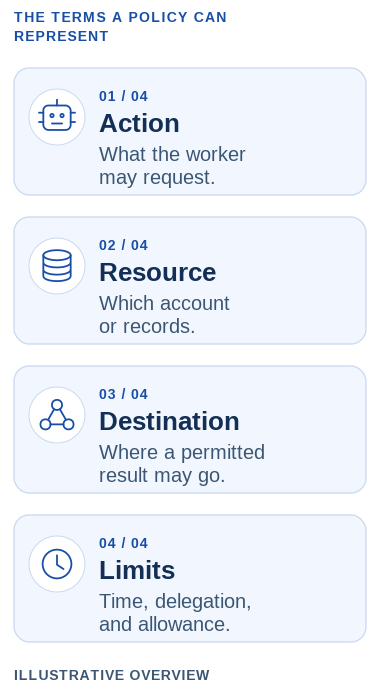
In an ordinary account, the same credential might reach both a private report and an export endpoint. An HTTP6 policy specifies which operation this worker may request, on which resource, and under what conditions. The representation matters because the person, worker, and service must agree on the meaning of an approval.
Representing an approval
The authority policy schema describes the structure of a policy. See also the JSON Schema specification. An implementation must also evaluate its meaning. A well-formed request to send a private summary to a new recipient still needs permission for that destination.
Connecting the evaluated policy to the approval
The grant commits to a specific policy. Editing a local policy file changes the bytes. A receiver verifies the commitment before applying the policy, then intersects the worker’s inherited permissions with local rules. This allows the service to refuse a request even when the grant chain is valid.
What a child may inherit
A child can receive permission to read one of two approved files for a shorter period. The original limits follow the child to the service, including any allowance shared with other workers. Read the policy model · See how W1 carries the grant