
Why the authors propose hereditary authority
A login can establish who opened a session. An autonomous worker may make a consequential decision much later, after several other workers have taken part. This paper asks which facts must accompany that later action to connect it to a person’s original decision.
Three parts of the argument
The Human Admission Client displays the terms to the person. The information-theoretic privacy research studies the private-reference relationship underlying admission under stated mathematical assumptions. The HTTP6 architecture then assigns each running worker its own identity and requires a service to check its grant before it acts. Each part answers a different question about the same exchange.
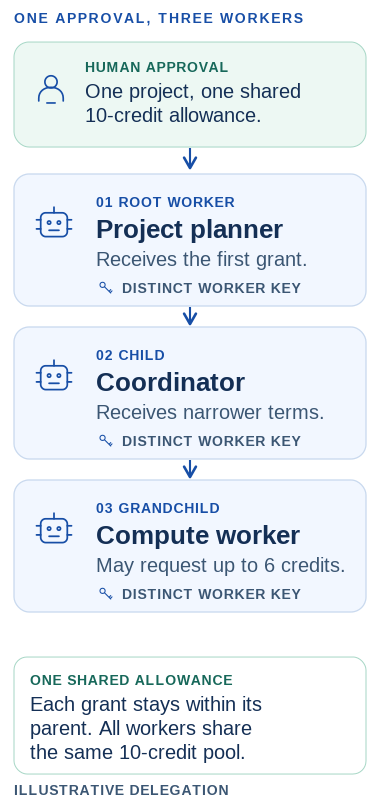
How to read a worked example
The authors use hypothetical workers and operations to explain their model. For an example about delegated spending, identify the parent’s allowance, the part given to each child, and the service that finally records the charge. The execution reports show how the corresponding question can be tested in code.