
HTTP6 needs a path from a human's normal browsing habits to a controlled execution environment. Its client strategy has three stages, each with a sharply defined capability boundary. The same protected message format and proof rules operate across the stages, so an early vendor can build an HTTP6 service without waiting for the entire public browser ecosystem to implement a new transport. The user-facing Human Admission Client retains the visible identity and proof experience; the server side of the HTTP6 reference architecture hosts the cryptographic channel, the Policy Decision Point, the sandbox, the Minting and Delegation Service, and the Consumption Ledger.
10.1 Stage one: HTTPS-compatible HTTP6 gateway
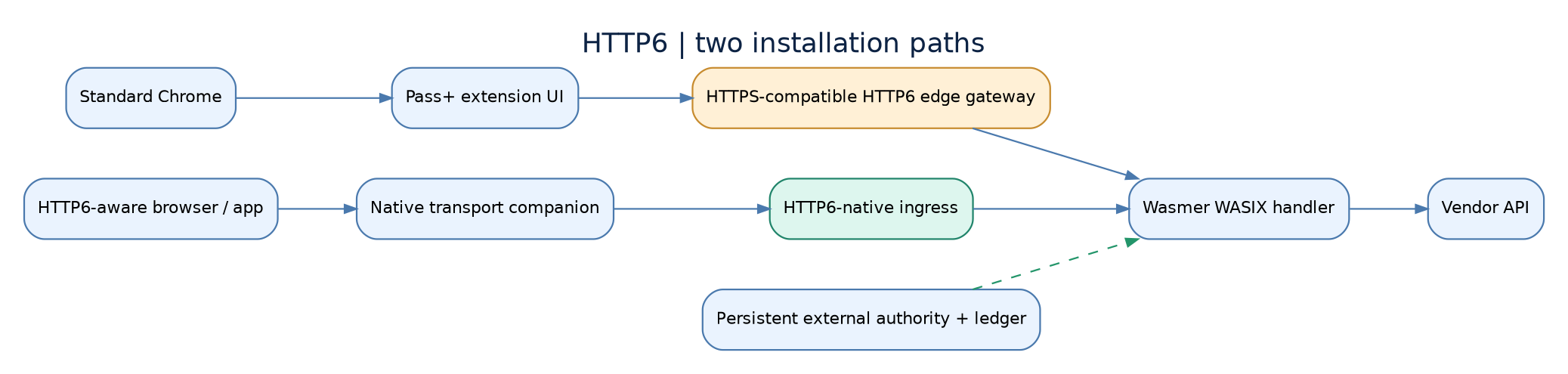
The first service deployment is the most attainable: an existing website or API operator deploys a new Wasmer-hosted HTTP6 gateway that uses a standard HTTPS listener. The browser opens the admission workspace using HTTPS, locally packages its circuit runtime, completes the accepted admission ceremony, then sends and receives encrypted HTTP6 frames to the gateway. Every inner request and response contains a fresh record proof. The outer TLS endpoint remains the compatibility transport for existing browsers and Wasmer Edge. The site can migrate high-value APIs to the proof-enforcing gateway before adopting a native HTTP6 transport.
The gateway handles discovery, protocol negotiation, rate limits, request-envelope validation, and routing to protected execution. The paired server twin runs under a selected WASIX/WASM runtime with bounded capabilities, and the proof authority/ledger sits in separately authenticated services. The vendor may keep existing content and database backends behind that gateway. Its only application-facing change is to expose a well-defined resource adapter that consumes a verified HTTP6 operation context.
The gateway must verify the inner proof before accessing a vendor backend. A request body copied from an earlier HTTPS exchange, even if byte-identical, is bound to a spent HTTP6 sequence and cannot trigger another effect. Existing login sessions can coexist during migration; the protected route enforces proof-first authorization regardless of a cookie's presence.
10.2 Stage two: extension-managed HTTP6 workspace
A Chrome extension can create an HTTP6 workspace page with the Human Admission Client visual identity and managed navigation controls. The user enters an HTTP6 resource address into the workspace. The extension mediates all navigation and resource fetching for that workspace through its controlled channel implementation. A remote HTML document can be displayed using a restricted renderer, a sandboxed view, or a trusted component model. URLs within the controlled view are parsed and rewritten into new HTTP6 records rather than becoming unrestricted network accesses from remote page scripts.
The extension's declared network-request API can block, redirect, or modify certain request and response headers. Its rules alone do not amount to replacement of the browser's TLS stack, nor do they provide complete control of arbitrary browser-fetched content. Chrome's declarativeNetRequest applies at specific browser network lifecycle stages; sensitive request bodies, response bodies, and cross-origin page execution need other controlled components. A production extension therefore uses an explicitly trusted HTTP6 view, a packaged runtime, and optionally a native companion for its proof state and transport. A content script running in a merchant page is an untrusted input surface, with a validated bridge to the extension service worker and protected host.
A packaged extension must obey applicable installation and code-loading policies. Manifest V3 disallows running remotely hosted executable JavaScript and WASM in the extension's own execution contexts. Remote website content is treated as data or rendered in a separately specified, properly isolated origin; downloaded executable circuit material follows its permitted distribution profile. The architecture can support managed enterprise builds where selected capabilities require separate permissions, release governance, or a native component. Every renderer and compiled artifact has a signed release identity.
The extension's image, font, stylesheet, media, and document requests are all issued by the HTTP6 client and checked under the active twin. A user click is captured as an application action, not reinterpreted from arbitrary cross-origin script. An http6:// link remains within the HTTP6 workspace unless the user explicitly selects an external web destination, in which case the appropriate normal browser security and origin rules apply.
10.3 Stage three: native browser transport or companion
A first-class native HTTP6 client opens its own network transport to an HTTP6-aware service, performs the enrolled handshake, and renders the verified response. It may be a custom browser, a managed browser fork, a native operating-system helper with an approved browser integration, or a dedicated desktop application. A Chrome extension can communicate with a registered native host through native messaging, subject to explicit manifest permission and allowed extension identity. Such a host can handle protected process state and transport without asking ordinary JavaScript to become a general-purpose network stack.
The native channel replaces TLS for that connection by implementing the same engineering responsibilities: authenticated peers, encryption, integrity, replay protection, secure key update, downgrade resistance, and error handling. Each request and response additionally carries the HTTP6 per-message proof and business authorization. A reverse proxy can simultaneously serve normal HTTPS and native HTTP6 to different client populations. Public web links, third-party APIs, package downloads, and provider integrations retain their defined transports until they adopt the new endpoint.
An operating-system network interceptor that silently rewrites arbitrary browser traffic would introduce origin confusion, protocol compatibility problems, and a large trusted code base. The preferred initial implementation is a transparent user-selected workspace with explicit enrollment, origin displays, and clear navigation semantics. A fully native browser can later give HTTP6 the same first-class URL handling that ordinary HTTP and HTTPS enjoy.
 { width=96% }