
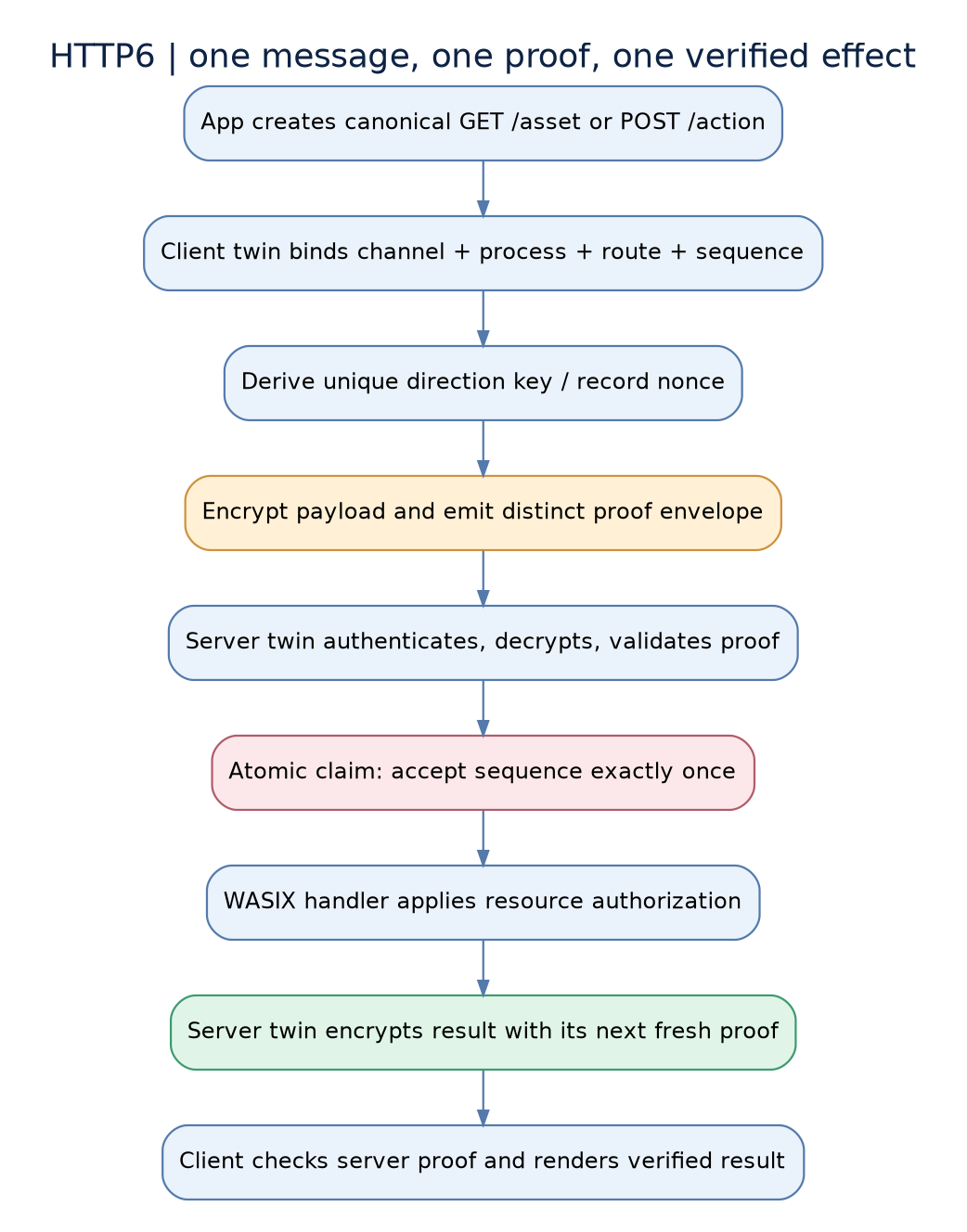
In the compatible transport profile, the outer HTTPS endpoint accepts a protocol-versioned opaque envelope, such as POST /http6/v1/records or a bidirectional WebSocket where supported. These are proposed interface examples, with exact names fixed by the implementing service and published SDK. The outer request performs no application action by itself; its protected HTTP6 payload is parsed and authorized by the twin service. Ordinary HTTP status codes can communicate transport failure while the inner HTTP6 response carries the business result and proof.
In the native profile, http6://service.example/path selects an HTTP6-native client/transport. A future custom browser could handle the scheme and its native secure channel directly. An installed companion can register a local scheme handler and render through a dedicated browser workspace, subject to the platform's scheme registration and security model. The encrypted record framing is transport-agnostic at the application layer: reliable byte stream, QUIC-like datagrams, or a constrained message bus may carry its envelopes after the security handshake is established.
Recommended error families are PEER_UNTRUSTED, ATTESTATION_FAILED, HUMAN_PROOF_REQUIRED, RUNTIME_GENERATION_CHANGED, ROUTE_CHANGED, EPOCH_RETIRED, SEQUENCE_CONSUMED, AUTH_TAG_INVALID, POLICY_DENIED, STATE_UNAVAILABLE, REKEY_REQUIRED, and OPERATION_UNCERTAIN. Errors are authenticated and minimized so a remote unauthenticated caller cannot probe private enrollment data. Structured audit events record the allowed state transition while raw proof responses and custody keys remain within their designated execution service.
 { width=96% }