
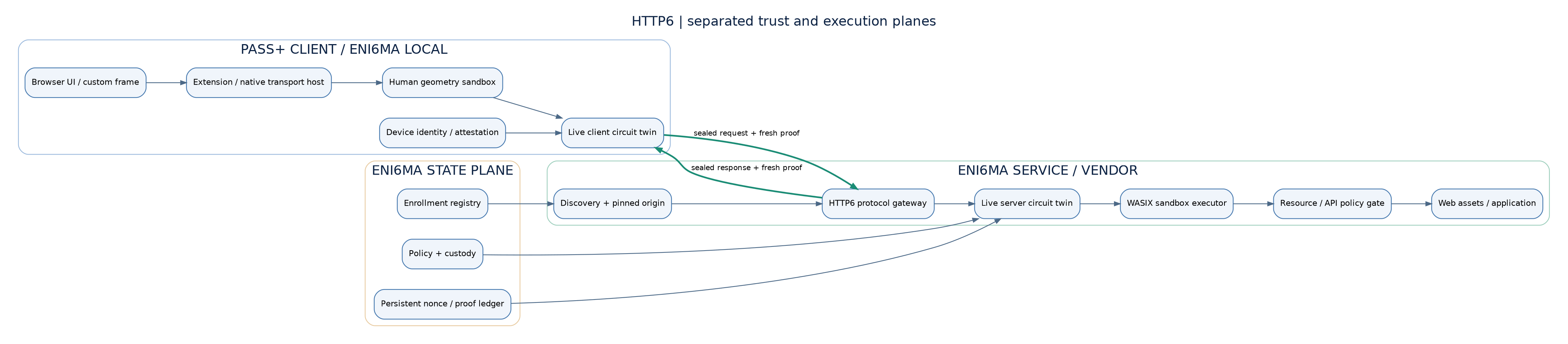
The existing web stack uses DNS and web discovery, TCP or QUIC, TLS, HTTP request/response framing, browser origin rules, and application authorization. TLS is an essential secure-channel mechanism in today's deployments; JWT is one possible credential encoding at the application layer, while an OIDC ID token has a distinct login purpose. HTTP6's goal is to replace both native-channel security and reusable bearer authority inside a qualified HTTP6 route. This includes peer authentication, encrypted records, integrity and freshness, per-request/response proof, one-use state, and process and route lifecycle rules. A native connection should no longer depend on a JWT expiry window to authorize its next operation.
A sophisticated existing alternative, OAuth DPoP, already provides proof-of-possession binding for tokens and a unique proof per HTTP request. HTTP6 therefore should be compared against both ordinary bearer-token deployments and sender-constrained deployments. Its proposed additional design dimensions are a human-opened execution generation, admitted circuit twins, explicit process and machine identity, payload-bound bidirectional records, retained one-use state, controlled route mobility, and WASIX sandbox enforcement. A persuasive security analysis treats these as composable protocol obligations with explicit attack tests.
The resulting authorization rule can be written as a predicate:
ACCEPT = VerifiedPeer AND AdmittedCircuit AND LiveGeneration AND ApprovedRoute AND FreshSequence AND AuthenticRecord AND PolicyPermits AND StateConsumed
A business resource receives the decrypted request only after these checks pass. An HTML renderer receives the document only after the response passes the corresponding reverse-direction checks. The same rule scales from a first page load to an API call and an agent-to-agent exchange.
 { width=96% }