
HTTP6 separates a human admission circuit from an autonomous service circuit while preserving one trust model. The human circuit opens a verified admission challenge, admits a particular local process, and establishes a scoped parent authorization. The machine circuit enters the corresponding oscillating relationship using enrolled hardware evidence, measured execution and a delegated policy. A fleet can include thousands of child circuits, but each child possesses a distinct identity, route, operation scope, and live proof state. One successful human superuser ceremony can approve a policy tree for those children; it does not produce a reusable master bearer credential that any child can copy and wield elsewhere.
A parent policy declares the maximum number of descendants, allowed service classes, approved machine inventory, process measurements, origins and ports, network route policies, permissions, transaction budgets, lifetimes, and human reapproval triggers. Child generation is a controlled authority operation. The newly authorized scheduler requests a child identity from the Minting and Delegation Service, the target machine presents its attestation, the Minting and Delegation Service checks the child's requested policy against the parent, and the scheduler issues a one-shot bootstrap invitation addressed to that exact child runtime. The child constructs a fresh HTTP6 twin with the remote service. A child cannot mint a more privileged sibling from its own local policy unless the parent explicitly delegates that operation.
This produces a hierarchy of root human admission → fleet authorization → machine-specific child issuance → process-generation admission → channel-specific oscillation → per-message proof. The human is the authority for the selected task set. Individual automated agents become authorized participants rather than containers for a common long-lived API secret. Every child can be suspended or retired by advancing its policy or fleet epoch. A fleet-wide emergency shutdown retires the parent and all descendant admission generations according to the enrolled revocation policy.
13.1 Machine attributes and the qualified path
An enrolled automated machine has a verified device key, attestation reference values, an approved runtime measurement, a current boot counter or equivalent monotonic identity, and an expected workload. The policy can also record network IP ranges, named IPv6 destinations, interface MAC identifiers, gateway identities, selected VLAN, data center zone, and route templates. These network features enforce placement and routing rules; the machine's attestation and private keys prove its stronger identity. The remote server checks current network observations and service-origin authentication before accepting each new channel epoch.
A machine reboot creates a fresh process generation and fresh channel keys. Under attested_auto policy the machine can rejoin automatically if the registered hardware and runtime pass attestation, its route satisfies policy, its fleet epoch is current, and the authority grants a new bootstrap. Under human_on_reboot, the machine sends a request to an administrator enrolled in the Human Admission Client and remains held until an authenticated approval creates the new generation. Under break_glass_only, even a properly attested machine waits for the designated emergency operator ceremony. These policies let low-risk infrastructure resume quickly while giving high-impact financial, custody, and administrative services direct human control.
13.2 Recovery authority tiers
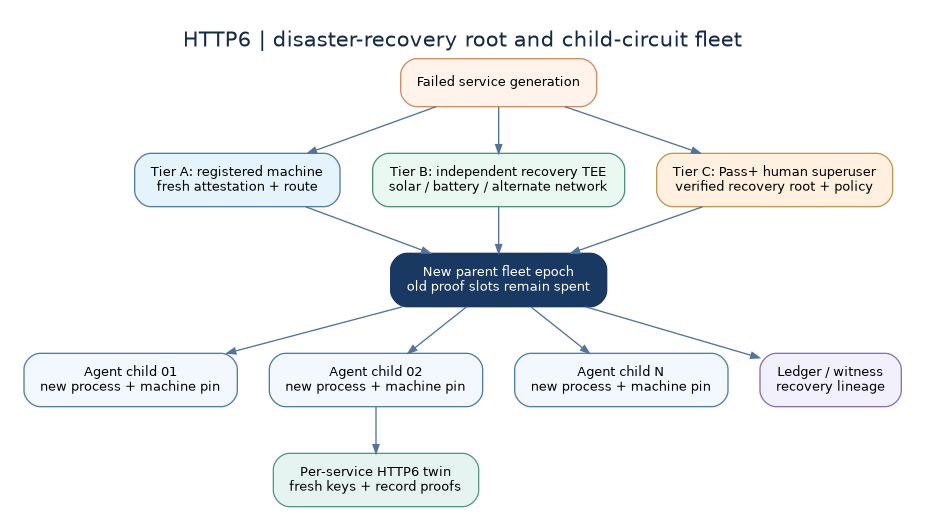
The architecture uses three distinct recovery tiers, each creating fresh authority rather than reviving old sequence positions.
Tier A , ordinary attested reboot. A machine loses power, a cloud instance is replaced, or a WASIX guest exits. Its enrolled device and orchestrator supply fresh attestation; the Minting and Delegation Service verifies code measurement, route and fleet epoch; the service creates a new channel and starts its oscillation. Current event and consumption state come from durable stores. The procedure restores approved automation with minimal operator intervention.
Tier B , independent recovery TEE. An organization installs a physically and operationally separate recovery machine with hardware-backed keys and pre-enrolled, narrowly scoped disaster authority. The machine might be a solar-powered laptop with independent battery storage and an alternate network path. Its power autonomy and communications autonomy reduce common-cause failures affecting the primary data center. The TEE/HSM or equivalent protected runtime stores a designated recovery capability and monotonic state; solar power by itself supplies availability rather than cryptographic trust.
On a primary-site outage, the recovery machine attests its own identity and current code, reads the latest independently retained checkpoint or signed recovery policy, and requests a new disaster epoch. It enumerates the permitted machines and services, applies the authorized restart policy, and mints fresh, machine-bound child bootstrap ceremonies for the replacement fleet. If the alternate network is available, it coordinates new HTTP6 twins directly with reachable services. If all outside network paths are down, it can prepare sealed, signed recovery plans and local authorizations for later delivery to pre-enrolled recipients, with a defined validity window and monotonic epoch. Actual remote services become active only after they can authenticate the recovery authority and reconcile the currently accepted state. Offline work therefore preserves a controlled recovery plan rather than pretending to complete an unreachable remote authorization.
Tier C , human-superuser restoration. If the independent recovery TEE is unavailable, a designated administrator performs an enhanced admission ceremony using a pre-enrolled disaster-recovery route. The recovery policy may require two authorized humans, a threshold of protected shares, a sealed offline recovery kit, or a physical console at the surviving trust root for high-impact installations. The operator authenticates through locally verified geometry against a known recovery authority and approves a proposed disaster epoch, destination set, and bounded child-family policy. An accountable recovery signer commits the transition and distributes fresh authorization seeds or recipient-addressed bootstrap records to the surviving machines. This is one human proof that authorizes a school of controlled progeny, followed by individual machine and route admission for each child.
When a central authority and every enrolled recovery appliance have been destroyed, the installation follows its root-of-trust reconstitution procedure. The organization must possess a surviving pre-registered recovery trust anchor, offline protected credential material, or an explicitly governed replacement-root ceremony. If all trust-anchor material has been lost, a new root identity must be established and distributed through authenticated out-of-band administration before other machines can trust it. Human knowledge alone cannot make a destroyed signing key reappear. A sound disaster plan defines this material before deployment.
13.3 Disaster recovery invariants
An emergency restart increments a recovery epoch, independently of ordinary channel counters. Every old runtime generation is retired or suspended, and no old nonce becomes available again. The recovery ledger records the operator and recovery machine attestations, approval policy, source checkpoint, affected service families, new epoch, selected recipients, generated child bootstraps, acknowledgements, and first valid request proofs. Every child receives a unique new process and channel generation. The system can therefore restart a school, a cluster, or a data center from one human-authorized event without circulating a reusable fleet password.
A disaster policy defines exactly when a child may run and which duties remain held until additional review. For example, a fleet of web-cache agents may restart automatically; payroll settlement and credential exports may require a second human; signing authority may require quorum. A compromised service can be omitted from the replacement family even if it previously belonged to the fleet. Parent authorization never overrides the application owner's transaction limits or the service's own policy enforcement point.
Failure scenario 1: local utility power loss. The main data center loses electricity. Primary twins time out. The independent recovery machine remains available on its battery/solar supply, and its trusted ledger reference identifies the latest accepted state. When replacement workers boot, they enter a fresh attestation and per-machine admission sequence; stale proofs fail the epoch check.
Failure scenario 2: primary fiber outage with alternate communications. The main connection fails, but the recovery TEE has a cellular, satellite or separately provisioned private connection. The recovery authority verifies the alternative route against its own explicit policy, creates a disaster channel epoch, and issues targeted child bootstraps to reachable sites. Human browser clients with a strict route policy still require new human admission after route change.
Failure scenario 3: independent TEE process crash. A watchdog detects that the backup authority process terminated. Rebooting its operating system alone gives it no continuing channel proof. The protected machine identity and current recovery policy permit a fresh attested activation only under its designated tier-B rule. Failure of the machine attestation, tamper state or recovery material routes activation to the human-superuser tier.
Failure scenario 4: total loss of backup recovery devices. A designated administrator opens a separately registered human recovery entry point, proves control through the Human Admission Client, participates in any required co-approval, and establishes a new parent fleet epoch through the surviving root trust. Each child subsequently creates its own keys and proof stream, allowing hundreds of services to return under one approved organizational recovery decision.
Failure scenario 5: stolen child WASM circuit or cloned virtual machine. A copied binary or VM image reaches a different server. Its attempt to use the old circuit identity is bound to the previous machine, process generation and epoch. The service requires fresh machine evidence and route membership. Copying historical witness outputs provides consumed sequence positions. The cloned process must be separately admitted before it can participate in an authorized twin pair.
Failure scenario 6: stale database restored from backup. A previous ledger snapshot appears to forget spent proof positions. The service compares its state with independently retained witness/checkpoint or disaster-epoch evidence and holds operations when current state cannot be established. It resumes after state reconciliation or fresh authorized epoch transition. This is essential because runtime-bound proofs still require retained replay history to make consumption meaningful.
Failure scenario 7: malicious operator requests a huge fleet. The root policy limits delegated child count, allowed service images, destinations, resource budgets and permitted operations. A request exceeding its policy enters held review. The event is logged under the human identity and epoch, while each granted child remains independently auditable and revocable.
13.4 Recovery UI and operator workflow
The admission recovery console should present a compact disaster summary: affected fleet, unavailable service count, current recovery authority, machine inventory, last verified checkpoint, pending route changes, required approvers, and projected child instances. The operator selects a recovery policy, sees each privilege class, and approves the creation of a new fleet generation through the admission challenge. The console displays the new parent ID, issued children, successful attestation, channels established, held exceptions, and any incomplete business effects requiring reconciliation.
The experience distinguishes authorization, deployment, channel establishment, and business readiness. A human may approve the fleet and still have downstream workers unavailable because they lack power, accepted software, route access or a valid checkpoint. Each level is recorded separately. An offline approval package is sealed to its intended recipients and opened only by the authenticated machine, with the current policy epoch enforced when connectivity returns. A delayed package from an older epoch is refused.
13.5 Suggested policy profile
schema: http6.fleet-recovery.policy.v0
fleet: research-datacenter-west
root_admission:
  mode: human_admission
  roles: [fleet_superuser]
  approve_child_policy: true
  max_children: 512
  high_impact_actions: second_human_approval
ordinary_machine_restart:
  mode: attested_auto
  require_measured_runtime: true
  require_current_fleet_epoch: true
  approved_routes: [private_ingress, registered_service_endpoint]
independent_recovery:
  mode: pre_enrolled_tee
  power: autonomous_battery_solar
  alternate_network: authorized_disaster_link
  checkpoint: independently_retained
  issue_new_epoch: true
catastrophic_recovery:
  mode: human_superuser_ceremony
  recovery_root: pre_enrolled_offline_or_surviving_root
  create_new_parent_generation: true
  child_admission: machine_attestation_and_route_policy
  preserve_consumed_history: true
child_policy:
  per_machine_identity: required
  per_process_generation: required
  per_message_proof: required
  independent_revocation: true
This YAML is a source-level illustrative policy schema, not an already deployed service configuration. The deployment implementation must define signing, validation, authorization precedence, version migration, and storage semantics for each field. Any operator-side edit to fleet policy requires an authenticated administrative operation and an audit event.
 { width=96% }