SDK integration
This API is one early implementation track in a global mission for identity privacy and cybersecurity for everyone. The destination is information-theoretic security grounded in the Rosario-Wang formulation, geometric ciphers, and commitment, replacing cryptographic primitives whose guarantees depend on computational assumptions. ENI6MA is the commercialization and licensing arm for this technology. This API specifies how bounded authority, proofs, enforcement, response verification, and ledger evidence can operate across an HTTP exchange. The global security moonshot describes the human problem, its consequences, and the future this technology seeks to enable.
The proposed Python, Rust, Go and C# SDKs provide basic proof and ledger verification. The proposed Node.js SDK connects to the local WASIX pilot through private agent and ledger sockets. Profiles http6-wasix-delegation-01 and http6-wasix-delegation-02 create and validates native proofs for committed successful responses, in addition to request proofs and resource-side enforcement. The earlier http6-wasix-delegation-00 profile remains supported and has no native response proof. Profile 02 additionally records failure response proofs. All use synthetic autonomous fixture origins and fixed children at agent startup.
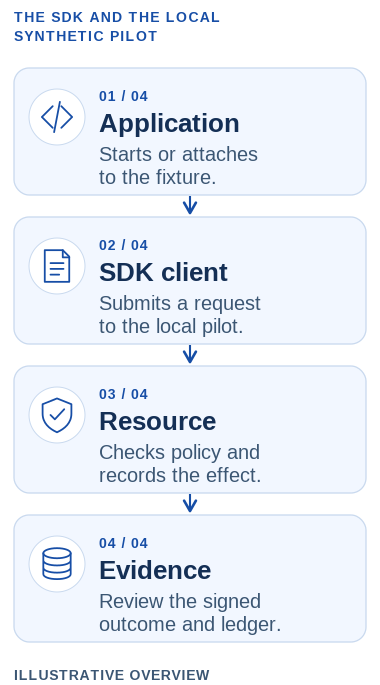
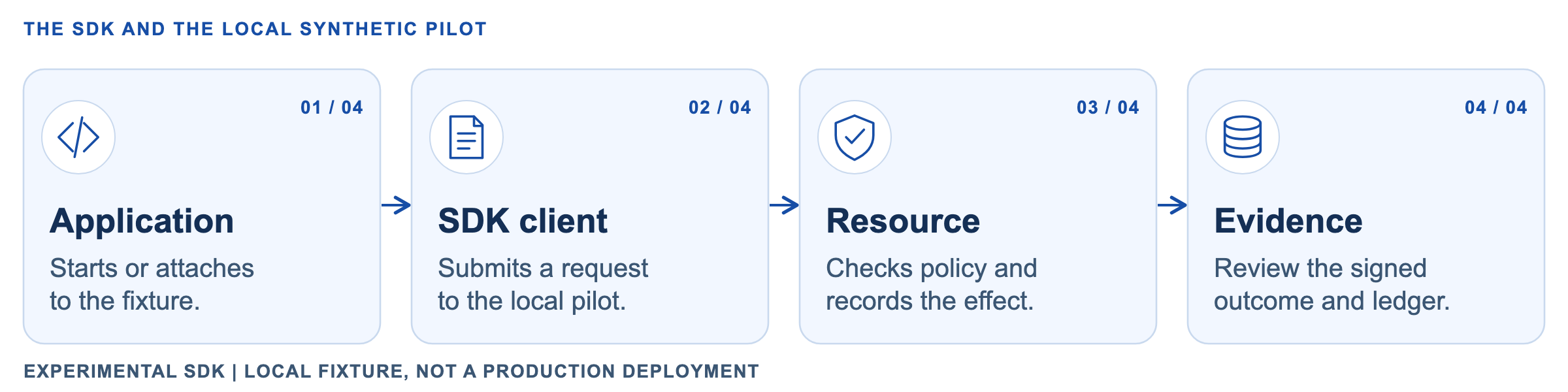
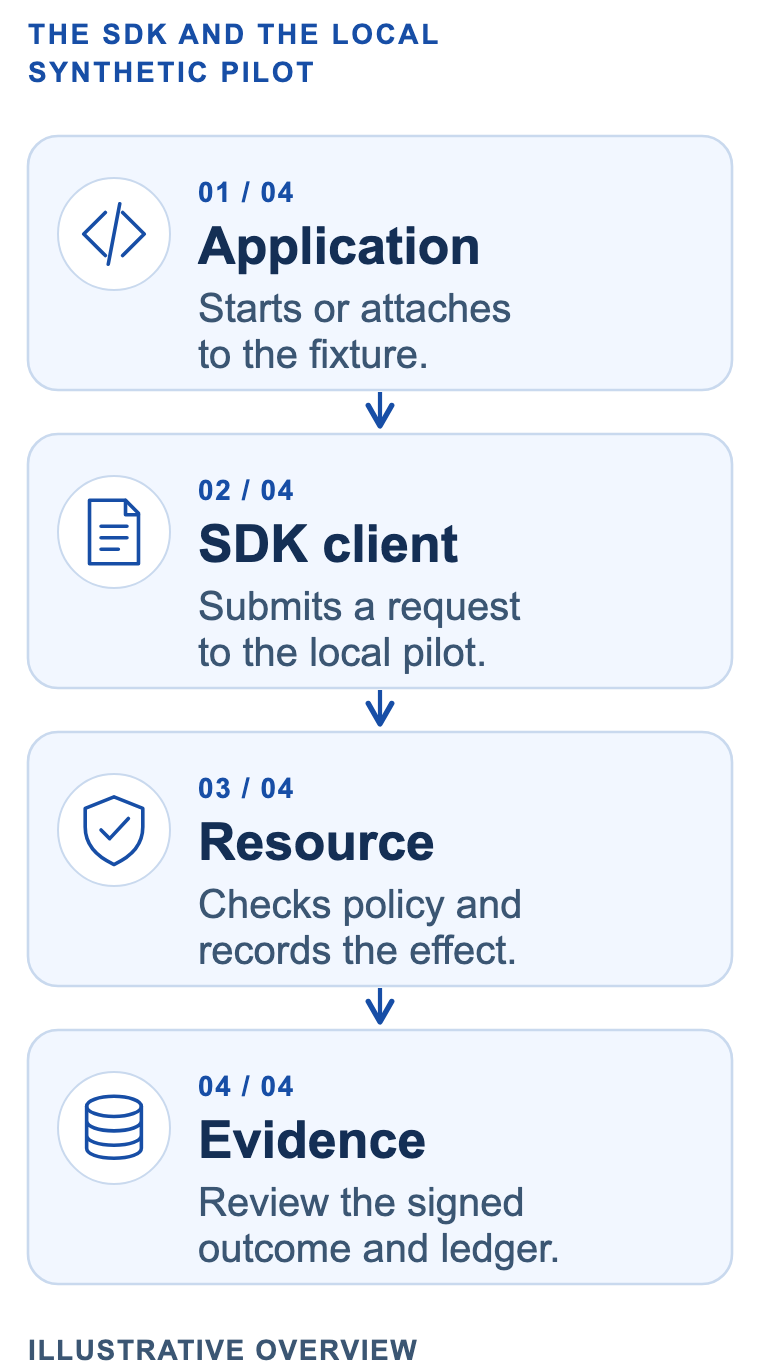
View larger SVG (opens in a new tab) View larger SVG (opens in a new tab) · Download PNG Download PNG
From an application checkout, install the local package after cloning this repository:
npm install /path/to/http6-sdk/packages/sdk
import {PilotClient} from '@http6-org/proposed-sdk';
import {join} from 'node:path';

const stateDir = '/private/path/to/a-new-state-directory';
const client = await PilotClient.startFixture({
  pilotBinary: '/path/to/pilot/bin/http6-pilot', stateDir,
  expectedProfile: 'http6-wasix-delegation-02'
});
try {
  console.log(client.capabilities());
  const receipt = await client.invoke({
    op: 'payment-1', audience: 'wallet', resource: 'merchant-payment',
    args: {network:'regtest', recipient:'merchant-a', satoshis:'250'}, holdSeconds:4
  });
  // In a deployment, provision trust pins independently of the socket and state directory.
  const ledger = await client.events({pinnedLedgerKey: independentlyPinnedLedgerKey});
  const responseProof = await client.verifyNativeResponseProof({
    response: receipt, evidenceFile: join(stateDir, receipt.responseEvidenceFile),
    operatorKey: independentlyPinnedOperatorKey, ledgerKey: independentlyPinnedLedgerKey
  });
  console.log(responseProof, ledger.verification);
} finally {
  await client.close();
}
startFixture is limited to a new state directory and creates the pilot's fixed fixture circuits. attach connects to an existing pilot without taking ownership of its lifecycle. invoke submits an operation to the pilot's policy gate. catalog and resolve read ledger objects. events verifies the returned signed event chain under an independently configured ledger key; it does not prove the server returned its latest head or that an external effect occurred. verifySpend invokes the pilot's separate historical wallet verifier with independently configured operator and ledger pins.
For profiles 01 and 02, verifyNativeResponseProof compares the supplied response to its evidence, then invokes the compiled verifier with independent operator and ledger pins. Its result is historical verification at the signed ledger-event time, not a finding that the grant is currently active. The method rejects profile 00. Profile selection is explicit; attach and startFixture reject an unexpected profile. General mintChild() is not exposed through the pilot agent API.
Direct mint and verifier integration
WasixCircuits starts the existing mint and verifier guests through Wasmer. The integrator supplies the root policy, route manifest, certified autonomous origin, operator pin, trust configuration and callbacks that register and verify root and child evidence with its state authority. admitRoot verifies the root through the designated verifier before registration. mintChild uses the existing mint and a distinct child guest, verifies the family, and provisions the child and verifier after the registration callback returns. proveRequest runs the existing prepare, challenge, answer, attest and signed-request sequence. verifyRequest asks the existing verifier to check the result.
import {WasixCircuits} from '@http6-org/proposed-sdk';
const circuits = await WasixCircuits.start({binDir: '/path/to/wasix-delegation/bin'});
try {
  const identities = circuits.identities();
  // Construct and authenticate originCert and trust for these identities.
  await circuits.admitRoot({policy, manifest, originCert, operator, ledger,
    semantics, trust, registerRoot: verifyAndRegisterRoot});
  const child = await circuits.mintChild({birthId: 'birth-reader-1',
    holder: 'reader-1', policy: childPolicy, registerFamily: verifyAndRegisterFamily});
  const packet = await circuits.proveRequest({holder: child.holder, op: 'read-1', intent});
  await circuits.verifyRequest({holder: child.holder, package: packet});
} finally {
  await circuits.close();
}
These are local process adapters, not a sandbox or protected key store. The registration callbacks must contact the intended state authority and verify its durable acknowledgement; returning without doing so does not register anything. The direct-circuit test uses an in-memory callback only. If registration or activation fails after minting, the deployment must reconcile or quarantine the partially created grant. The current guest accepts a bounded policy vocabulary and certified autonomous fixture. This direct mint path does not implement human admission. The resource, ledger and response-proof workflow is supplied by the profile 01 and 02 pilot services.
Separate request and response proof model
The repository's Python adapter loads the existing Rosario-Wang validation kit and executes its local request and response proof flow:
python3 reference/review_channel.py /path/to/HTTP6_RosarioWang_Validation_Kit
This adapter mints the kit's synthetic child, verifies a request and separate response, rejects response modification and replay, and inspects the kit's local ledger. It uses the review model's own proof and ledger formats, not the WASIX agent's format.
A second local bridge composes both paths for a synthetic wallet example. It places the complete WASIX proposal inside a review-model request proof, sends that proposal to the running pilot, verifies the pilot's signed wallet evidence using independently supplied operator and ledger keys, and places the actual pilot response inside a separate review-model response proof. It also tests a modified response.
python3 reference/pilot_bridge.py KIT_PATH STATE_DIR PILOT_BINARY OPERATOR_KEY LEDGER_KEY
The bridge is an optional trusted local integration with two separate verifiers and two ledgers. Profile 01 also supplies native response proofs directly, without this bridge. It keeps their wire profiles and verifiers separate. The example uses synthetic data.
The repository contains the SDK, tests, proposed schemas and source documents. Please open an issue with questions or implementation feedback.
Proposed HTTP API contract
The read-only API navigator maps proposed control operations and their request and response schemas. Its example server is intentionally invalid and its unimplemented operations are not the existing WASIX pilot API. The cross-runtime examples exercise the actual local pilot.